Sunday, April 9, 2006

She Looked on Tempests and Was Never Shaken


Today is the second anniversary of my mother's death, April 9. I wanted to share again this wonderful tribute that my daughter Katherine wrote two years ago.

I knew her as my Grandma, and I knew her best when I was a kid or a teenager, and that seems to be the only way I can write about her. So. Here is the best composite sketch I can come up with:

She enters the room, and calls out “greetings, greetings.” (Or, if it’s our house in Baldwin, she shakes her head, says “chaos, chaos”, and promptly misplaces her purse.)

She is always, always moving—that’s the first thing you have to know about her. This occasionally verges on the absurd--she used to do laps around McDonald’s by the side of the highway on long trips, and I remember Aunt Sherry once whispering to me “right, no more coffee for you”, as Grandma completed her fourth circuit of the kitchen and stairs on a rainy day in New Woodstock. And when she breaks more bones in the course of a year than the typical casualty rate of a Koch ski trip, or you’re trying to pack up your college doom room, it’s downright unnerving.

But for the most part it’s a very good thing. I don’t know how many countries she went to, or how many lobbying trips to Washington D.C., but I remember our trip to France together; and her descriptions of how Ted Kennedy’s new wife seemed to be doing him good, and which Congressmen were decent guys in spite of being Republicans. And I’ve more than lost count of the times she took my sisters and me to the pool, or the beach, or to visit one of our relatives. But I’ll never forget that the way back from Mark and Maura’s house requires pulling into the Croton Library parking lot and doing a U turn. (At this point, of course, it’s partly because Uncle Mark refuses to tell us the alternate route.)

She also took us into New York City a lot, but the trip to Manhattan I remember the best was the least successful. I was in eighth or ninth grade, and Patricia was in fourth or fifth. Grandma took the two of us and my sister’s best friend into New York for Patricia’s birthday. We were going to Central Park and a museum, I think—I’m not sure because we never got there. Grandma’s route to New York was even more circuitous than the way home from Croton. The Long Island Railroad was too expensive, and parking in Manhattan was right out, so she would drive to a municipal parking lot in Queens where you could park all day for $2, and then walk ten minutes or so to the subway—I don’t remember which station, somewhere near the end of the E line. This time, though, our meter was broken. I suggested we move to another space, but she was not willing to waste those quarters, so she wrote a note and taped it to the parking meter. Unfortunately, in the confusion, she left her car keys sitting on the driver’s seat—she realized this somewhere under the streets of Manhattan.

We turned around, and no one had broken the window or stolen the car. But here, I thought, was an object lesson for Grandma—moderation in all things, including frugality.
She’d have to pay for a locksmith, which cost much more than the extra quarters or, God forbid, a train ticket.

She did no such thing. Instead she asked a rough looking young man on a nearby sidewalk to help her break into her car. He was happy to assist. When he could not get the door open, he called over a friend. Who said, after a few more unsuccessful attempts to pick the lock, that what they really needed was a crowbar, but since he didn’t have his around and Grandma was not crazy about that, they’d better ask another friend. Who said, and I quote, “what we really need is a Puerto Rican.”

I don’t know whether they found a Puerto Rican, and I don’t remember how long we stood there, Grandma smiling encouragingly and offering occasional advice, or how many neighborhood kids were debating the best way to break into a Toyota Camry by the end—it’s probably somewhat exaggerated in my memory. I can tell you that in the end, the simple yet elegant coat-hanger-through-the-window-to-pull-up-the-button-technique did the trick. The lock suffered some damage from the good samaritans’ enthusiastic efforts, but you could get the door open more often than not. And from then on, we parked in the driveway of a high school friend of Grandma’s—10 minutes further away from a subway station even further down the E line, but $2.00 cheaper than the municipal lot and much less risk of a break in.

(As I was writing all of that, I realized---it’s not quite accurate to say she was always moving. I just remembered the nights in Henry Street when she would tuck us in, and tell us to lie still and imagine we were floating on a cloud. There were also her “yoga,” excuse me, ‘yoger” exercises. But if I ever want to finish this, I should move on, so….)

She was incredibly smart, and incredibly interested in the world around her—whether it was the history of the China lobby or when any of her nieces, nephews and grandchildren would finally, in her words “find yourself a mate”.

She also had the strongest faith of anyone I’ve ever known. Maybe it was that combination, that fierce intellect and that certain belief and trust in God, that made her so strong. Much more often than not her beliefs coincided with the Catholic Church, but when they differed she was not shy about saying so…On most of the many nights I slept over at the house on Henry Street, I wore a polyester blend, 1970s issue T-shirt that said in glittery bubble letters “When God Created Man, She Was Only Joking.” And I remember her telling me about sneaking in inclusive language to her frequent readings at St. Martha’s, much to the new parish priest’s chagrin.

And on the much more frequent occasions when her children and grandchildren did something she disapproved of—she let us know in no uncertain terms, but there was never a single moment’s doubt that she loved and accepted us anyway. I’ll always think of her when I read these lines from Shakespeare’s 116th sonnet::

“Love is not love
Which alters when it alteration finds,
Or bends with the remover to remove:
O no! it is an ever-fixed mark
That looks on tempests and is never shaken.”

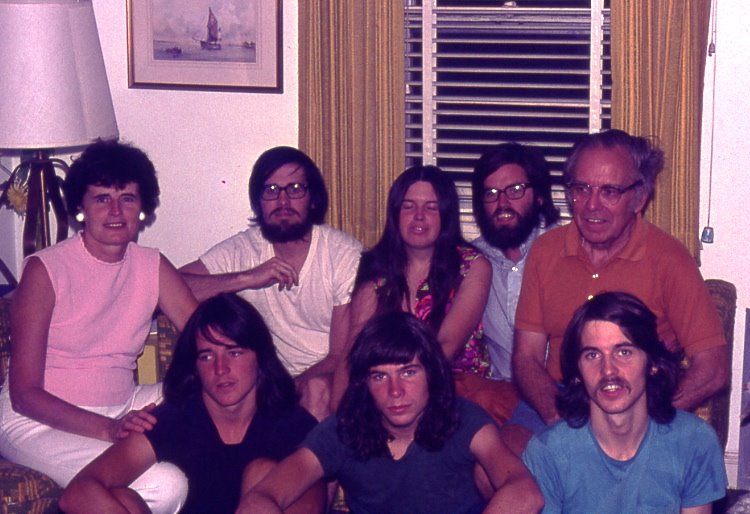
I know, it’s a love poem—and a truly bizarre choice for a description of one’s grandmother. But—getting back to photographs, and with apologies for the embarrassment this may cause certain unnamed relatives of mine--I defy you to find a better or funnier illustration of Shakespeare’s words than the picture posted above of Grandma Mary, Grandpa Joe, and their wayward offspring in the early 1970s:

She was in many ways a third parent to me. I think I’ve spent more time with my husband at this point, but I’m not at all sure of that. She was someone who could be counted on absolutely, without question or condition. She looked on tempests and was never shaken, and I’m not only talking about my uncles’ hairdos when I say that. I don’t think I’ve ever owed as much to, or cared as much about, anyone to whom I expressed it so little. But she was not the most demonstrative person either, so maybe she knew. I lack her certainty about God and heaven, but I hope very much that she knows now.

Monday, January 16, 2006

First Family Car

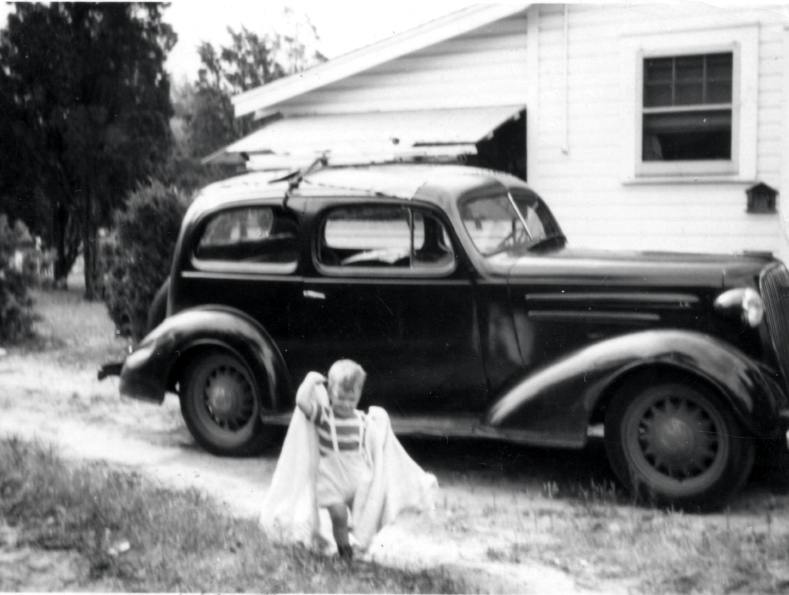
Richard, Stephen, and I are having trouble remembering and dating our family cars. This was the first. I remember that we had to bring big jugs of water even on hour trips because the car would overheat the need water. This must the car Mom learned to drive in. She failed her first test. When parking, she ran over a curb that was obscured by feeds. Richard, Stephen, and I had to go along for driving practice. I wound up doing the same thing in Maine. My kids loathed practicing parallel parking.

Gardening

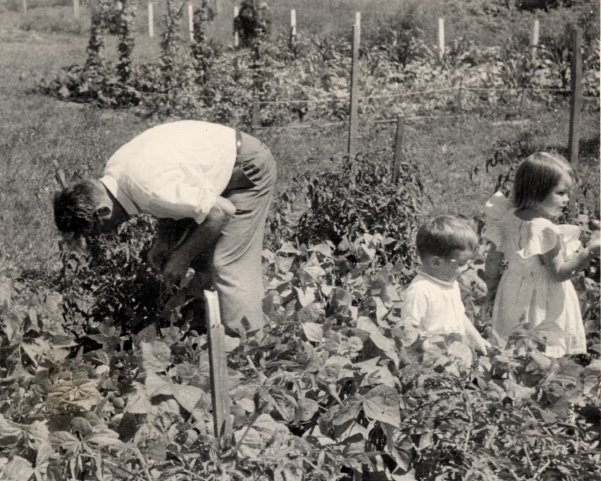
Dad was a gardener; he grew vegetables. Flowers were Mom's department, but she took over growing vegetables after Dad died. Neither Mom or Dad were great cooks, so I don't remember specific family recipes. What I remember are delicious fresh vegetables--tomatoes, string beans, corn, zucchini, broccoli, lettuce. No tomatoes or corn have ever tasted as good.

In retrospect I understand that gardening was the perfect way for Dad to unwind from his actuarial job and his long commute. I remember his encouraging us to start our own little gardens. I remember helping him plant strawberries. I remember picking off Japanese beetles from the plants and putting them in a jar of something that killed them.

Peter and Michael have definitely inherited the gardening gene. I tend to garden in the spring, then neglect the garden during the hot summer.

Saturday, January 14, 2006

Mary: January 16, 1943

Dear Joe, Saturday morning in the office is as usual very dull--not that you'd know about such things, having loafed all your life on the seventh day of the week--so I'm free to steal a few minutes to say hello to you. Then too, since most of my time this weekend will be divided between the books and hot coffee, I'll probably not have another chance to write.

Due to the paper shortage you'll note that I'm typing single space, although all the best secretarial books insist that you should use double space for personal letters. While in the midst of licenses and priorities, I'd like to inform you that we do not sell them--the Government does that. On the contrary we have to obtain them, and it's a hard job getting them. If you've been reading your newspapers lately (or maybe the El Paso Times isn't up to date), you'd know that there are innumerable forms to be completed before Washington will even consider granting priorities, allocations, and licenses. I hope now that you realize that procuring licenses is not as simple as persuading poor unsuspecting individuals to buy insurance policies.

This morning promised to be just another dull dreary Saturday, but soddenly the old sun has appeared and changed the whole outlook. To herald the appearance of Mr. Sol is the air-raid whistle which means noon time has come; I'm glad because hunger is gnawing at my stomach. You know army life would never do for me if the meals are as bad as you say. In no time though you'll probably become adept at dragging the available supply of food from those Texans, just as you were in obtaining subway seats from helpless women. Well, I guess I'll have to interrupt this letter anyway to get my mail out before closing time. See you later.

In a few short hours spring has come! How do I know? Well, when you can use a porch which has no heat, then it's spring, isn't it? Yes, it's the first time since November that we've even stayed on the porch more than two minutes. Usually we just consider that a part of the great outdoors. Of course you will probably pick me up on the above and remark something about my being on the porch for a whole hour one night. But why do I let my thoughts stray like that. To get back to spring--after work I walked down Fifth Avenue to the 42nd St. entrance to the subway just so that I might enjoy the warm sunny day. You see you're not the only one who takes 16 mile hikes.

Our coats were tossed open; thermostats were shoved down to 60, the solid earth became soft and muddy, and the world seemed to be whistling a tune of spring. Yet the other sure signs of spring were missing--there were no cheery songs of the birds or the first green buds on the trees--so I guess it isn't here yet. How I wish it were; then I'd have an excuse for this sudden attack of spring fever.

Mother insists that the cold blustery winter has just begun; rather she hopes so because we just bought a new grate for the fireplace which burns coal and we haven't yet experimented with it. By the way when dashing through RHM on Monday, I happened to see your sister Jane. However as I was rather late and anxious to get back form lunch on time, I didn't take time to stop. Besides she seemed to be persuading a reluctant costumier to buy some little do-dad.


Joe: January 14, 1943

Mary, Mary,
Don’t you know that you’re not supposed to upset the equanimity of privates in the United States army by writing letters at two o clock on the morning? Why, just to list some of the effects: Last night I had planned to write a letter to Leroy A Lincoln, President ye dear old Metropolitan thanking him for his letter of Christmas greetings and for the wallet which “my friends and associates of Mother Met” had sent as a Christmas remembrance. No letter for Leroy last night nor tonight and after all he was my boss and will be at some time in the future. Then there is the physiological effect of just 4 1/2 hours of sleep last night. Being systematic I usually budget my time: I just think of you, Mary, during the daytime hours; from 9 to 6:30 is reserved for Morpheus. But not last night, I couldn’t fall asleep until after midnight and I was wide awake at 4:30, back in Queens Village. Evidently the red bus no longer is running in the early hours of the morning because of the gasoline situation.

Twenty four hours later I’m in no better condition. I read the NY Daily News of Jan. 6, 7, and 8 and all the drippy stories in the January American to try to get back into a semblance of my phlegmatic self. All to no avail.

If it were anyone else but you, Mary, I could dismiss it as an example of sleep-writing. But not Mary Nolan--her vivacity is at its zenith at the time “is it tonight or tomorrow morning.” Just seven weeks ago tonight we said goodbye, Mary--they must have been Biblical weeks--I’ll have to stop this because by Jan. 23 I’m supposed to be a full-fledged soldier having then finished my basic training. It wouldn’t do when the Sgt. gives the command Cadence Count for me to suddenly shout out twice a four word phrase which my heart drums out continually like a bolero instead of the usual 1-2-3-4 1-2-3-4. I’m afraid to think of the possibility that the seven weeks may become 7 times seven weeks--Halt, Private Koch.

Joe: January 5, 1943

Since you have seen fit to comment on my writing ability (was it some Nolan blarney or some Hunter satire?) I feel brash enough to give you a short lesson in mathematics. To wit, 3 x 4 =12. Simple, isn’t it? You are probably wondering what prompted this pedagogical outburst and I should let you guess, Mary. But just writing your name, Mary, makes me softhearted so I’ll tell you. Well along in your last letter (on page 9 to be exact) you stated and I quote, “here I am on my third booklet.” Yet on the last page of that very same booklet in a P.S. you wanted me to note that your letter was only 15 3/4 pages. You know, Mary, that sooner or later the Hunter Math dept. will get you for at least one course and where will you be? I think I’ll have the Koches ship my calculus book to Queens Village. After all, if your wishes for an end to World War Ii during 1943 are fulfilled, I’ll need an assistant mathematician to help me with my actuarial examination.

I notice that you glibly mention our letters crossing in the mails. It’s my belief that one has to master the intricacies of Einsteinian Time-Space in order to keep our correspondence straight. Look at the following diagram:

Do I hear Mary Nolan saying, “Yes, he fills up his letter with charts and diagrams so he can boast of his extended epistles; if I did that I wouldn’t have to make mistakes in arithmetic.”? Oh, I forgot you’re still a Home Eco. major--at least until the new semester--so you won’t have to answer that question. While we’re on the subject of home economics, I think it’s mean, Mary, to mention your prowess (is that a bit too strong?) as a cook when I’m some 2500 miles away from your kitchen. I’ll get even, though. In my next letter home I’ll tell my mother; for over thirty years she’s been looking for someone to cook Sunday dinner for the Koches. In that time she got a number of additional Koches but no cooks. That’s a German pun, and like all German jokes, lousy.

Joe: February 10, 16, 1943

February 10, 1943-- By now I’m in such a state about you, Maring <-- well that crossed out word is an example; I tried to combine Mary and darling in one word--Mary darling, that I’m joining your mother in worrying whether you go out without galoshes in the snow. Remember, dearest, if your mother doesn’t insist, Pvt. Koch insists that you wear your galoshes. I can’t even see the inconsistency of my position--I who haven’t worn rubbers or a raincoat for years....

February 16, 1943--Gee, darling, I didn’t know Lana Turner was unhappy in her marriage to Stephen Crane. I didn’t even know she was married. Tell me more. I can realize why she is unhappy, he is much too old for her. Why how many years ago was it that he wrote “The Red Badge of Courage?” Little did I know when I wrote a book report for 4th term high school English what a gay old dog the author of that book was. Going in for sweater girls, tsk tsk! And tut tut. I wouldn’t have felt have so guilty either about that report. We were supposed chose a book and summarize it in about a dozen statements. I picked “The Red Badge of Courage” because it was short and secondly because the chapter headings were complete sentences that merely had to be copied word for word, obviating reading the book. Much to my embarrassment--for I had a conscience in those my younger days-- the teacher singled me out for praise of my choice of good literature....

Joe: January 27, 1943

I’m closing my ears and getting back to a most important subject--correction; to me the most important subject--you, Mary dearest. I’m still puzzled by the outcome of a decision to go to McAveighs instead of Loon Lake Colony because the latter place seemed to be a little too sophisticated for a simple minded guy like Joe Koch. I just remembered the connotation attached to simple minded--but just one moron joke mary. I’ve gone along for a good many years carefree, rather self-complacent and then--I remember seven days at McAveighs, a bus ride from Albany to New York, Bambi, a Brooklyn-Philly game, some shows, a few movies, a couple of football games featuring Fordham--luck Fordham-- a ballet, a rodeo--what I’m trying to say is that I remember only Mary, Mary dear, dearest Mary, lovely blue-eyed Mary, mary pretending to be asleep on the red bus, Mary so alive, Mary bowling, Mary and her Hobokens, talkative Mary, the Mary who says she is silent and subdued, the Mary who says she isn’t naive just because she has principles, the Mary who puts stamps upside down on letters to new Mexico, Mary the student, Mary the only girl--just Mary.Then I count on my fingers that it’s just for five months that I’ve known her--and for two of those months I haven’t seen her--It upsets all my theories and a theoritician who finds his theories upset is a dangerous man, darling Mary. He finds his fountain pen to no avail, so he’s thinking of and loving you, Mary dear, across 2500 miles and hoping that Queens Village is tuned in by telepathy. With all my love, Mary, love that must be real because it is so incoherent, I love you, Mary, and will always and always.

Joe: January 17, 1943

Sunday Afternoon--All is quiet and peaceful--three hard-working soldiers are enjoying a siesta--inaudibly, thanks be, correction four; one is studying a dictionary--a victim of three new words-a-day disease, probably; another is painfully writing a letter--not me, I enjoy writing letters which begin Mary dear.

The only sound is the humming of the fan in one of the barracks’ as it blows out warm currents of desert air. Fortunately, my mind is miles and miles away. watching a dark head buried in a book of scientific lore; otherwise there would be five siesta-ers. A pair of blue eyes looks up from the heavy book, which I can now observe to be entitled Physiology for Students of Home Economics, but resolutely look down again on page 47--only 281 more. Alongside the printed book is another--a notebook which, at last, is completed; although, here and there, its contents are not clear--I wish that Peggy wrote clearer but borrowers can’t be choosers and only he last three quarters is copied. What is this? The diagrams in the notebook are but black and white--no crayon colored charts.

If it were but a picture all would be still. But no, I can hear the sound of grinding teeth--do I have to interpolate that they are white and were noticed by me in that period from August to November--as the ideal cell battles with a sarcolena with a lonely neuron looking on. Wait, another sound can be heard. A voice--yes it’s Kenneth’s--is saying, “Mary, Mary, did you hear how a moron powders her nose. No? There were five morons and they all ordered Coca-Cola, the other one ordered milk.” Another sterner voice is heard: “Frank, stop marching around, your sister Mary is studying. Sit still,; here’s a new Superman book to read.”

What is the focus point of all this solicitude doing? She’s making progress: a page is turned over, eyes race over page 48 and reach halfway down the next page. They stop then, puzzled--how did that New Mexican jackrabbit get tangled up in the carotid artery? Back to page 47 and ye old physiology textbook is turned face down and a hand--a left hand reaches for the notebook. This time the eyes are resolute; they ignore a bracelet whose blue stones are earnestly trying to reflect the glory of its owners eyes. Page after page is flipped by--ah here it is, the circulatory system. “The heart is a wonderful instrument: it pumps thirty billion times during the allotted span of three score and ten years...” The owner of these studious blue eyes pauses to absorb into her mind all this concentrated knowledge about the heart. Alas, that pause was fatal--her mind leaps to a consideration of other facts about hearts which are not contained in any textbook.

Mary! What is the use of my being in Queens Village this Sunday afternoon when you persist in wandering to a warmer Sunday afternoon out in the desert. I’ve glided from the New Mexican plateau to the lowlands of Long Island so you could study. After all, it’s only two days until the 19th and well you know Monday and Tuesday will be the two busiest days for the priorities and export license department; Pete will probably keep you working overtime Monday night; it always happens that way. Well, I’ve done my best, Mary--New Mexico it is.

Joe: January 8, 1943

Your appeal for pulse rate readings has appealed to the scientist in me.--stamps will not be accepted. You will understand that laboratory conditions are not ideal here at the Lordsburg Interment Camp so I will not be able to furnish exact figures on all the readings you need, Mary. However, here goes:
Sex: Male. (Thanks for placing me in the adult classification.)

Age: 29 years, 4 months, and 4 days--someone borrowed the latest issue of the astrology magazine
so I can’t verify this approximation. To find the exact number of hours and minutes up to this time (7:45 N.M. Mountain War Time) consult any astrology almanack for favorite time at which geniuses are born (I know the plural is genii but I don’t want you to receive the wrong impression.)

Pulse rate: All the following figures are at 15 second intervals.
1. Before meals: Too great a variation--the only meal that is worthy of being called a meal is breakfast and it’s too dark at seven o clock in the morning to take my pulse before breakfast. Since we’ve had stew for supper for the last seven days--stew consisting of everything left over from dinner all mixed together--any pulse reading before and after supper would be utterly unreliable: the before reading would merely show anticipated revulsion and the after one show you I’m tired of eating bread and apple butter for supper. Naturally this leaves dinner. However, I’m getting used to the dinners by this time and I’m afraid that if I observe scientifically any physiological reactions, it will disturb my digestion of the midday repast.
2. After meals: See remarks under “Before meals”.
3. Reclining: 18
4. Sitting: 17.
4a. Sitting but reading one letter from a certain individual who (as in all scientific treatises) will be nameless; besides I don’t want to make you overconfident regarding your literary prowess, Mary: 20.
5. Standing: 19.
6. After 1/2 min. of exercise: Well ignorance is a poor excuse for your snide remark about 1/2 minute exercise, but I accept it this time. I’ll have you understand, Physiologist Nolan, that even when I brush my teeth I undergo five minutes of very vigorous calisthenics. Since our formal calisthenics in the morning takes up a full half hour I’m afraid that this reading will be impossible to obtain. Besides it takes me more than half a minute to count my pulse beats for 1 seconds.
7. After a hot bath: Are you kidding? After a hot shower Pvt. Koch turns off the hot water and a forceful pray of icy cold water immediately cascades upon his manly physique. It takes a bettter man than me to count his heart beats under a cold shower--how do I know my watch is really waterproof; the jeweler didn’t say positively?

Please understand, Mary, that if I were using my own writing paper or even the U.S.O. letterhead, I wouldn’t clutter it up with tripe like the above. Insamuch as you own the prioroities and export licenses on this paper, Mary Nolan Inc., I suppose you can demand what you will....

This going to bed at nine o clock is getting me down especially on Friday nights, so last night I stayed awake in bed for over an hour philosophizing and poor you will have to bear the brunt of it. What started my mind gyrating was a jingle of Gertrude Stein’s which of course I don’t remember word for word--no one does--which goes something like this:
Jack and Jill went up the hill
Jack is Jack even though Jack is Jill, he’d still be Jack.
Somewhere in one of my philosophy courses I remember that the question of personality was brought up: “Why am I, I?” or “why are you, you?” I am not indulging in double talk. Well this was the starting point: I can’t remember any changes in myself since I graduated from grammar school--maybe beacuse I received a medical for general excellence at that time, I decided that I couldn’t be improved--even back in Jan. 1927 I was a pessimist. I wonder though, if my (illegible) had taken me out to the woods then, would I have recognized one Mary Nolan who was just then starting kindergarten? I doubt it for the twins were slightly less than four years old and Agnes was just about six so I looked upon all the younger fry as a great annoyance--especially the talkative ones. But I must have changed: now, when my thoughts turn to one youngster (of Gresheimer--classification of those who are neither children nor adults) the gleam in my eyes is definitely not one of annoyance; just for your information, mary, it’s one of longing--

I seemed to have wandered off track back in the previous paragraph--just shows I haven’t a one track mind. What I’m trying to get at is the fact that we do not recognize the process of evolution taking place within ourselved. We can look back at ourselves from the present time and recollect what we once were but we can’t point out any turning point. Probably growing older is a continuous process of accretion--we never lose ourselves, but just keep adding more thoughts, more emotions , and I trust more wisdom, not to mention such mundane things as(illegible), bad habits, etx. I’m not including you in the last category, but I already feel as if I knew you always, Mary. Yet I can remember a certain Sunday just one day less than twenty weks ago when I first met the Wisdom Alumnae Trio--well I was always warned that canoeing was a dangerous sport.

I promise you Mary, that in the future I’ll leave philosophy to the philosophers. How are the other Nolans--they can’t be in perfect condition if they let you cheat at Pick-Up-Sticks. I know that game and I also know that anyone that wins all the time does it by a crooked flip of the wrist as they let the sticks go....

Friday, January 13, 2006

Joe: December 25, 1942

The eastern skies are golden ocean that stretches from purple mountain to purple mountain. Over this glowing ocean, a halo of pale yellow reaches up until it is transmuted into the deepest blue. The shores of the golden sea are white sand, of course, but as they recede from the molten surf they become darker and grayer until a dull green color predominates. The cactus and yucca-studded beach stretches all the way to the brown mountains of the west which are roofed by the western sky trying to show that the Occident too is a colorful panorama. The blue-gray western clouds are blushing a genteel pink. Is it because they have seen the sun still beneath the eastern horizon or are they showing their anticipation of the home-coming moon--in all its white fullness sailing slowly serenely towards its western moorings?

The description is not so hot but it is an attempt to show that despite the radio and the jukebox, a white Christmas is not the only kind. In fact, I’m pretty sure that the first Christmas was more like our New Mexico one than the wintry Christmases of Queens Village and points north. All right, the fact that I’m writing letters on Christmas shows which kind I prefer. I think that all twelve of us who came down from Camp Upton feel quite lonely and homesick today.

I myself can’t conceive of being 2800 miles away from you and the Koches. Next door the bugler is practicing, outside cactus is growing, and if I look out the window I can see the desert all around and yet I still think that all I have to do is catch that next bus at Parsons Blvd and have you help me play with the various games and toys of the Nolan younger trio until Frank says, “Whose Christmas presents do you think these are anyway?”

Little Brother

I have always loved this picture taken in the fall of 1947. First, I have been amused by how blonde I am. More importantly, this might have been the last time I had the advantage over Richard. In my baby book Mom claims that "Mary Jo and Richard were always ahead of mother. Often though she forgot he was so small and played rough." I am dubious; he does not look intimidated. Richard was always a far bolder spirit than his timid sister; he resembles Mom much more. All our lives, I have never been sure when he is pulling my leg. For many years Richard made me feel guilty for pushing him down the cellar stairs in his walker; then Mom explained that the culprit was Lorraine Larsen. Significantly, I thought I might have wanted to eliminate him.:)

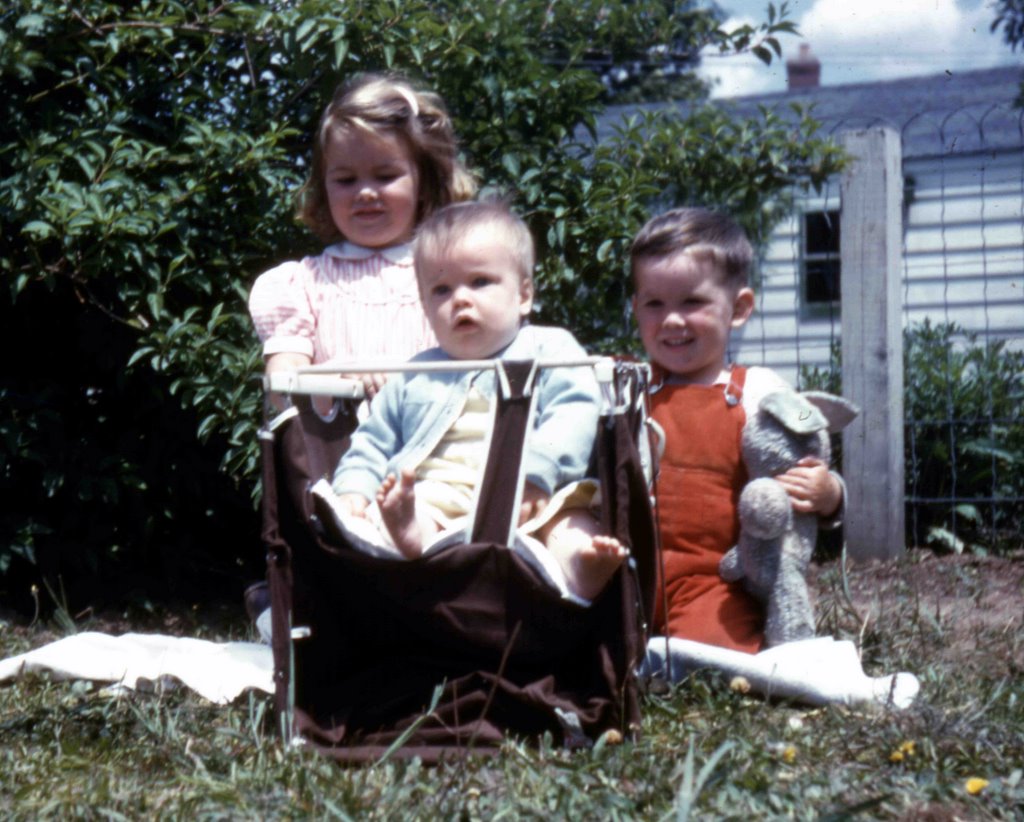
Mary Jo, Richard, Stephen, 1949

This was taken in the summer of 1949. I am just turning four; Richard is two and one half; Stephen is about 7 months. I do have some vague memories of Stephen as a baby, but they are not specific. Stephen and I were blondes to begin with; my hair is already turning dark. Richard always had dark hair; I think he has changed the least over the years.

Joe Meets Mary

Her name was Mary, of course. She was a blue-eyed, smiling, long-legged, cool looking girl--a trifle naive. A girl with class he thought when he first saw her,but young. A bus seems an awful place for things to start, but there was she on a bus going to church and planning to have a chocolate ice cream cone with sprinkelettes. He was going to church too, but she sat in back of him and that was that.

He said hello to her that afternoon or more likely she said hello to him. Again nothing happened--there are lots of shapely girls in blue bathing suits at a lake summer resort. The summer resort was one of those let’s-be-one’big-happy-family sort of places--it even had a social director and a social directrix. Naturally one afternoon there was a baseball game in which all the boys and girls (in those places they’re all boys and girls even if the boys and girls have big boys and girls of their own) were to participate. Well this particular boy and girl were antisocial or mutually social. They sat out the ball game on a raft. Long afterward he learned her reason why she was there but being a romantic still doesn’t believe it.

They talked about prosaic things--families and schools; after all he was a shy young man. She wasn’t. Maybe that is why he was sure it happened then. That’s the trouble with shy young men: they are not used to openhearted friendliness. He never knew what she saw in him, but for the rest of the week they were summer friends. He struggled a little bit--an inherent male instinct. Why one rainy afternoon they went to a Bing Crosby movie in separate groups. They had only a week, not even a full one.

However, this time it did happen on a bus. They had made some sort of plan to ride back to New York on the same bus. He from the summer resort, she from Albany where she was visiting. He was positive. She says it couldn’t haven happened then--that soon.

He didn’t know the proper method of courting a girl, not a beautiful one like her. Oh he was quite proper. The movies he took her to were always approved for adults and children. A baseball game, a few football games, a little bowling--that was about all. He didn’t have much time, altogether three months. He then went away as did twelve million other men young and old. Oh yes, he finally kissed her once. He was very proper and very shy and afraid she would say no.

Monday, December 19, 2005

Balding


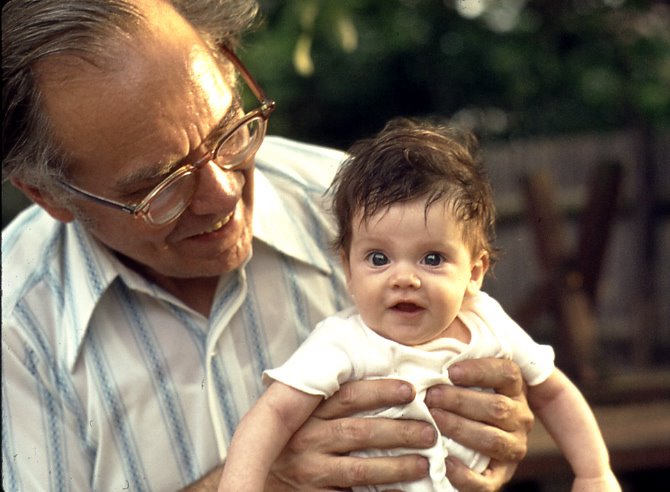
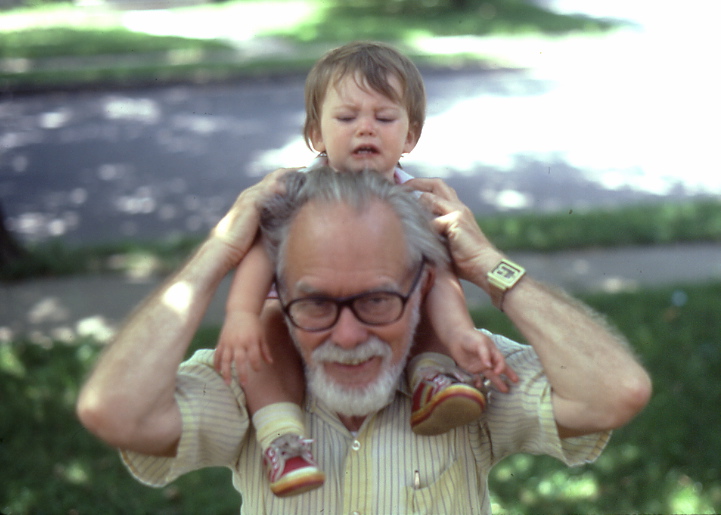
I've had several discussions with my brothers and daughters about whether Dad went bald. My recollection is that he developed a higher and higher forehead and his hair thinned, but he never got bald. These pictures confirm my memories. Compare this one of Dad and Patricia in 1983, when he was 70, with the one of Dad and Vanessa in 1973, when he was 59. He has gotten gray, but his hair has not receded that significantly. Dad grew his beard after he retired from Ebasco.

Penguins

This picture brings back many memories, whether fond or not I have to puzzle out. From first grade through high school, I was taught by the Dominican Sisters of Amityville. Richard was in St. Martha's first graduating class, and all my brothers graduated from St. Martha's; I was too old. I went to Holy Redeemer in Freeport for first and second grade and then Queen of the Most Holy Rosary in Roosevelt for third through eighth grade. Richard and I both went to St. Agnes High School in Rockville Centre; Stephen went to St. Mary's in Manhasset. Peter, Michael, and Mark went to Maria Regina in Uniondale.

The tall nun on the right was Sister Miriam Francis; she was the principal at both Holy Redeember and the Queen. She died last year at age 93, having worked well into her 80's. I wasn't surprised; in retrospect she was an amazing educator. A tall, elegant woman, she effortlessly ruled her 800 students with a clicker; she never had to raise her voice. One click, and we were instantly silent and attentive. She knew the name and the history of every student in the school. We all both feared and admired her, were willing to work hard for her praise.

I was a very good girl. In seventh grade Sister Miriam Francis told me I could not have had a more perfect record. So I was never the victim of a nun's wrath, never had an eraser hurled at me, never was hit by a pointer, never had to stay after school to clean the blackboards. My innate shyness was reinforced, however. Good students only answered questions; they never asked them.

The nuns were very young; many had not yet been to college but were expected to teach classes of over sixty students. Everything I know about English grammar I learned from the nuns; we must have diagrammed a thousand sentences. As I get older, my memories get better; I had more good teachers than dismal ones.

Koch Hair


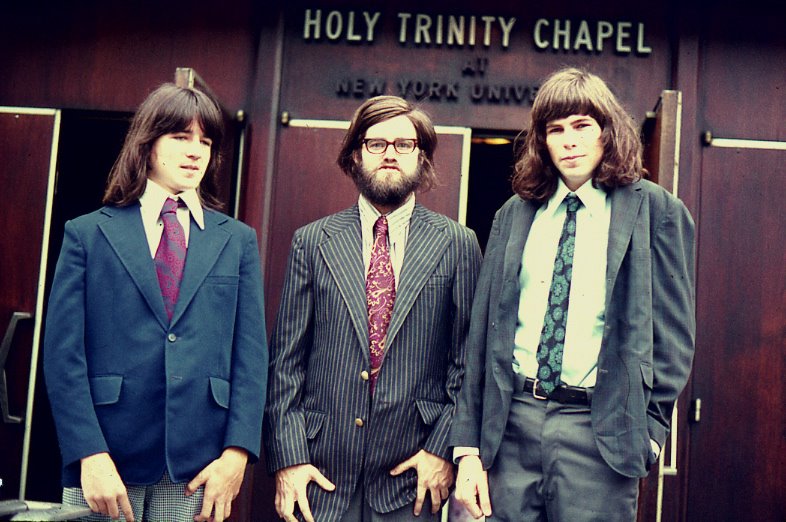
These pictures beg to be shared with everyone. The top one of Mark, Stephen, and Michael was taken June 16, 1974 at Peter's wedding to Merce's mother, Jacquelyn Blackstone. They got married at the New York University Chapel; Jacquie had just graduated from NYU. Mark was almost 15; Michael was 18; Stephen was 25. Richard has rejoiced in his good fortune at not being able to come and be included in this lineup. The family first met Michelle at this wedding.

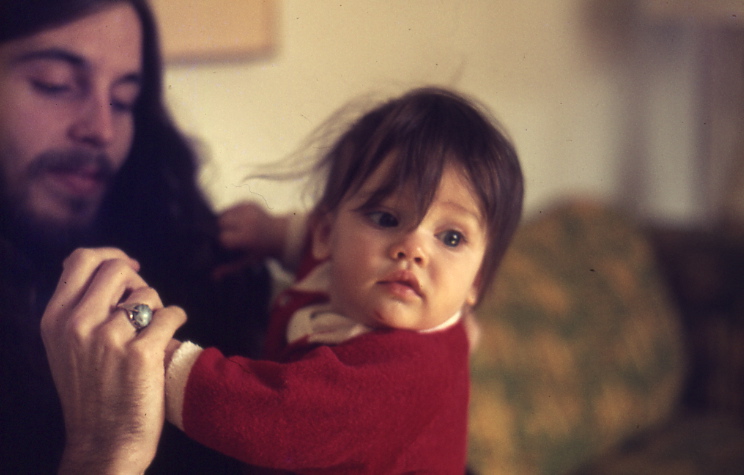
Thankfully, the groom had cleaned up for the wedding. This picture of Peter and Vanessa had been taken only six months previously.

Politics

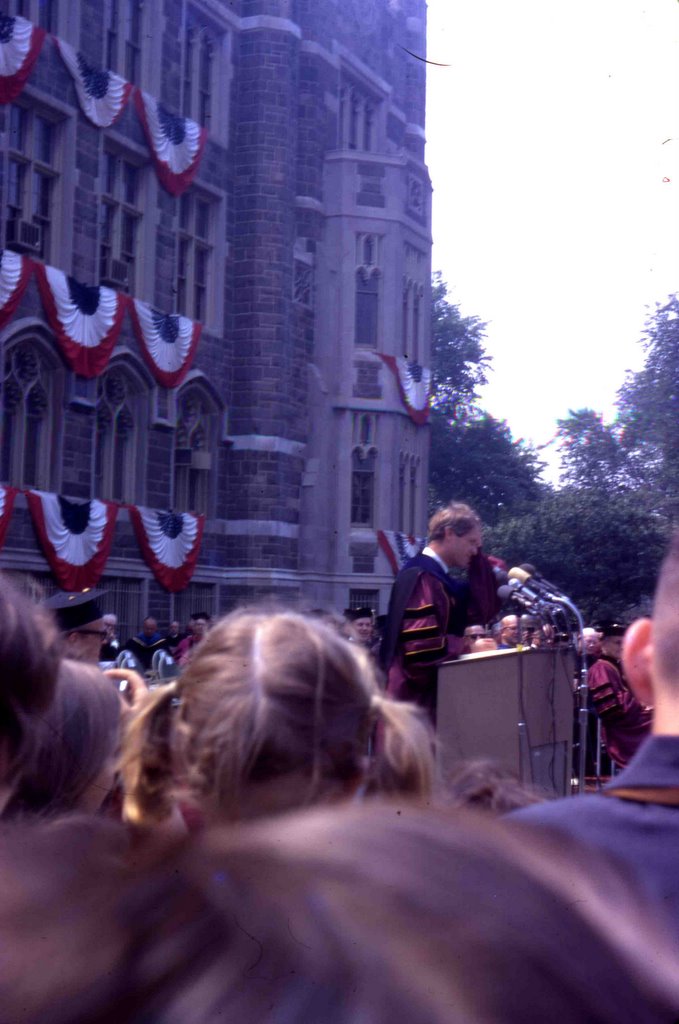
This is a picture of Robert Kennedy speaking at my graduation from Fordham University in 1967. Do I have to explain who he is? The younger brother of President John Kennedy, he served as Attorney General, then became Senator from New York. He was running for president in 1998 when he was assassinated June 5, ten days before my wedding to Chris Hawkins. I remember I had a final wedding dress fitting the day after the assassination, and I was in tears most of the time.

In the midst of a heated debate between Uncle Ken and the younger generation, I posted this account of my political evolution. I would love to hear everyone else's stories.

My first specific political memory centered around the duck and cover, hide under our desks, exercises that were a regular feature of my early school life from age 5 on. I knew enough about nuclear war to be terrified. We lived near to an air force base and I used to go out to the backyard, look up at the planes, and try to determine if they were American or Russian. I remember getting a book out of the library on aircraft identification. When I heard Joseph Stalin died, I remember asking if that meant no one would drop bombs on us.

In 1954 I had a severe case of the measles and Grandma Nolan came to help nurse me. She was listening to the Joseph McCarthy army hearings. Hatred of McCarthy's voice
might have shaped my entire political development. The other determining force was my obsession with John F. Kennedy. I first took an interest in political conventions in 1956, when I was 11. Kennedy made a brief try for the vice presidential nomination, and my mom mentioned he was Catholic, that there had never been a Catholic president. From 1956 to 1963, I read everything I could about Kennedy. When I was 15 I did volunteer work for his presidential campaign.

In high school we had political debates to imitate the famous Kennedy/Nixon debates and I represented Kennedy. What he believed in, I believed in. Gradually I moved to the left of his pragmatic liberalism. Certainly Kennedy was responsible for my decision to major in political science in college.

I cannot precisely date my interest in and commitment to civil rights. When I was a freshman, I joined my college's Interracial Understanding Group. I was envious of those college students who have the affluence to spend the summer down south registering voters and didn't have to worry about money to pay their tuition. Kennedy's assassination, occurring in the fall of my freshman year in college, devastated me. I felt like there had been a death in my immediate family. I quickly translated my political allegiance to Bobby Kennedy.

Gradually during college I became a pacifist. Opposition to the Vietnam War right from the beginning was the catalyst. My husband to be, Chris, applied for conscientious objector status and was willing to face jail rather than be inducted. We became very active in the Catholic Peace Fellowship, the Fellowship of Reconciliation, and the War Resister's League, all pacifist organizations. We went on several anti-war demonstrations both in New York and Washington. I briefly attended Stanford University where resistance to the war was at its height. Almost every afternoon, David Harris, Joan Baez's future husband, spoke out eloquently against the war.

My first job after Stanford was as an assistant to Victor Riesel, a labor columnist, who had been blinded by acid thrown in his face by the mob who controlled the waterfront he was exposing. One of my assigments was to read the AP ticker to him every day, clip articles in all the newspapers, labor papers. This was in 1968, when King and Kennedy were assassinated, when anti-war protect was at its height.

Sunday, December 18, 2005

Vanessa's and John's Wedding


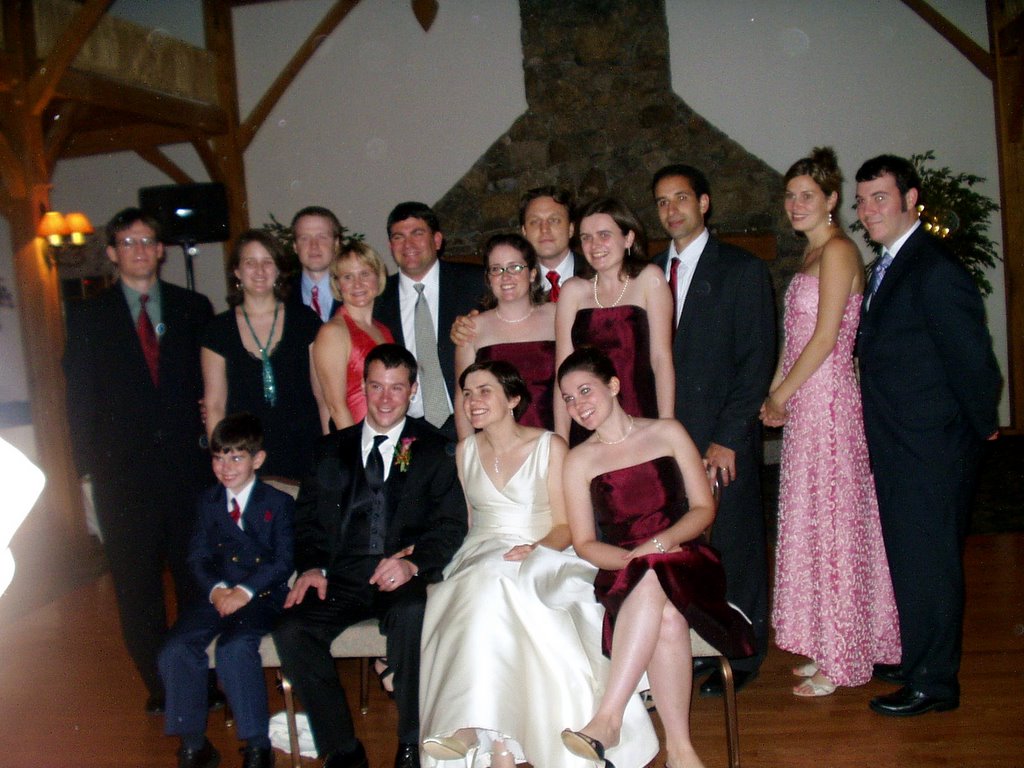
Vanessa loved this picture taken at her wedding ; she said she had never before been photographed with all her uncles. She doesn't remember the picture taken in 1974, the year after she was born, or she might not have realized these scary people were relatives. Let me identify the desperadoes. Rose is sitting on Kathy's lap. Next in the back row are Stephen, Mary Jo, Michael, Richard with Daniel, and Mark. In front are Jacquie, Peter, Phoebe, Chris, and Vanessa.

Unfortunately we didn't take a cousins picture at Vanessa's wedding. To see the wedding pictures, go to the Vanessa and John Wedding site. I will be adding many more over the next few weeks.

Elizabeth's and Brent's Wedding

The little boy sitting next to Brent is Matthew, Chris's sister Lynn's son. I assume I don't have to identify everyone, but I will anyway. Back: Joe, Elizabeth, Patrick, Rose, Brian, Vanessa, John, Katherine, Josh, Mercedes, Matt. Mercedes's husband Matt couldn't make it. This Matt is Patricia's Matt. In front is the Hawkins Matt, Brent, Elizabeth, and Patricia.

For wedding pictures, please go to Elizabeth's and Brent's Wedding Page, For gorgeous professional pictures, go to www.pictage.com and search for the Hawkins/Radcliffe wedding, September 23, 2005. You will have to register (it's free) to see the pictures.