I was born the day after Trinity, the first atom bomb test. From age 5, duck-and-cover, hide-under-our-desks drills in my Catholic school were as frequent as tests. I was terrified of nuclear war. We lived one mile away from an air force base. Whenever I heard planes, I ran out into the backyard and tried to to determine if they were American or Russian, using my library book on aircraft identification. When I was 7, Stalin died. I asked my parents if this meant we would not be killed by atom bombs.
In 1954 I had a severe case of the measles, and my Grandma came to help nurse me. Grandma was a lifelong Democrat since she voted in the first election open to women. With loathing, she was listening to the Joseph McCarthy army hearings. My eyes hurt too much to read, so I listened obsessively. Hatred of McCarthy's voice probably shaped my entire political development.
In 1956, just turning eleven, I fell madly in love with Jack Kennedy as he made an unsuccessful bid for the vice presidential nomination. I was initially attracted by his Catholicism; ten minutes later I was smitten by his intelligence, wit, and charm. I was luckier than his other women. Loving Jack Kennedy was wonderful for me. From 1956 to 1963, I read everything I could about Kennedy, politics, American history.
What JFK believed in, I believed in. Gradually I moved to the left of his pragmatic liberalism. Certainly Kennedy was responsible for my decision to major in political science in college. Kennedy's assassination,during the fall of my freshman year in college, devastated me. I felt like there had been a death in my immediate family. I quickly transferred my political allegiance to Bobby Kennedy, who was the keynote speaker at my graduation from Fordham in 1967.
Planning to get Ph.D. in political science, I attended Stanford University where resistance to the war was at its height. Almost every afternoon, David Harris, Joan Baez's future husband who was later jailed, spoke out eloquently against the war. I was studying political science as a quantifiable science. I knew Harris and the protests were the real political science, and I dropped out, throwing away my free ride to college professorship.
After Stanford, I worked for Victor Riesel, the blind labor columnist. When he was exposing waterfront racketeering. acid was thrown in his eyes. He was too proud to learn Braille, so he hired bright young political women to be his eyes, so he could write his daily colulmn. I skimmed 8 newspapers and 40 labor newspapers and read to him anything that might provide column ideas. The Internet equivalent was a constantly running ticker tape. All day, everyday I read and discussed the assassinations, the riots, Vietnam. The shattering world was my job.
I had gone to bed very late the night Bobby Kennedy won the California primary. As the radio woke me up, I didn't understand what they were saying for several minutes. I thought they were talking about someone else. When I called my finace, I was crying so hysterically he thought something had happened to my parents or brothers. JFK's assassination was 10 days before my wedding. The day after I had a final dress fitting. I cried the entire time, not caring if I had a wedding dress of tears.
I became a pacifist. Opposition to the Vietnam War right from the beginning was the catalyst. My husband Chris applied for conscientious objector status and was willing to face jail rather than be inducted. We became very active in the Catholic Peace Fellowship, the Fellowship of Reconciliation, and the War Resister's League, all pacifist organizations. I have mostly seen Washington behind a picket sign. Freezing,I stood in front of the White House I stood in front of the White House and shouted the name of a dead soldier during the March of Death.
My husband was turned down for Conscientious Objector Status, as most Catholics were, even though he appealed the decision up to the Presidential Appeal Board. We knew he was going to be jailed, probably for 3 years, for refusing induction. But in 1969 the Selective Service instituted the First Draft Lottery. The days of the year, represented by the numbers from 1 to 366 (including Leap Year Day), were written on slips of paper that were placed in capsules. The capsules were mixed in a shoebox and dumped into a deep glass jar. Capsules were drawn from the jar one at a time.
The first day number drawn was 257 (September 14), so all registrants with that birthday were assigned lottery number 1. Men of draft age (those born between 1944 and 1950) whose birthday fell on the corresponding day of the year would all be drafted at the same time. Only the first 195 birthdates drawn in the 1969 lottery were called to serve. The lottery night was among the worst of my life. I arrived home from work when they had reached 50. As time when on and they didn't call out Chris's birthday, I was convinced he had been in the first five. His number was 339. He was spared jail.
Showing posts with label Politics. Show all posts
Showing posts with label Politics. Show all posts
Thursday, October 21, 2010


Sunday, February 8, 2009
Mothers, Lawyers, Politics

My mother had 6 children and 15 grandchildren. Born in 1921, she wanted to be a lawyer. Her father died when she was 17, and she had to go to secretarial school, not college. Her family required her financial support. From 1945, she raised 6 kids, was an active volunteer in her church and community. When my youngest brother was 5, she returned to college, graduated the same day I did in 1967, became a fervent feminist, got her master's degree in American History, and taught high school.
After she retired, she worked for Bread for the World, an international organization fighting world hunger. When my dad developed Alzheimer's Disease, she became a support group leader, then the Long Island legislative lobbyist for the Alzheimers Association. Later she became a lobbyist for long-term health care. She was an officer of the Women's Ordination Conference, fighting for women priests. She would have been a superb congresswoman or senator, much more effective because she didn't go to law school. Her obituary characterized her as a trailblazer.
I was raised Roman Catholic and have 45 younger first cousins.
Like my mother, my aunts, their friends, my friends' mothers could not afford to attend college before they had children. They had their large families very young, then got their degrees and started their careers by the time they were in their early forties. Since their children were largely grown, they were able to focus their tremendous energy, talent, and experience on their jobs.At that time being a mother of a large family was considerably more respected than it is now. My grandmother had 8 children; my mother had 6; I had 4. The extensive volunteer executive experience of my mother and my aunts was more likely to be acknowledged. My aunt went to law school when she was 40 and in a few years was chief counsel to the president of a large university. Now even many professional women don't seem to value women who chose to emphasize mothering instead of careers while their children were young.
I stayed home with my children full-time for 14 years, then got two master's degrees. I was a political activist, editor, childbirth educator, breastfeeding and parenting counselor, researcher, nursery school vice president and treasurer, PTA leader, volunteer teacher and librarian, mental health advocate. i Even in the traditionally female fields of library science and social work, I often felt that my experience as a mother and community activist was not acknowledged and valued. In social work school, I often was regarded as a beginner, and the tremendous amount of knowledge I had gained by reading, childrearing, and counseling, activism was regarded as cheating, because I hadn't put in the requisite years on the job.On the job,. I was given the responsibilities of an experienced librarian and social worker, but paid and promoted like a beginner.
Ann Crittenden has a provocative book, If You've Raised Kids, You Can Manage Anything." Anyone who doesn't think PTA activism is political experience has not been involved in Long Island PTAs:) Mothers' executive experience seems invisible to most people because they are not highly paid.
We need to broaden our conception of political experience. We cannot draw our political leadership from graduates of Yale and Harvard Law Schools. Sixty US Senators are lawyers. That certainly rules out most people, who could not possibly afford law school. How much of the adversial, partisan character of our politics is shaped by the exceess of lawyers? A Congress of PTA presidents would be considerably more effective.
Women need not follow the traditionally male path to political power. Otherwise they have to be Hillary Clinton's age before they can aim for major office and then are dismissed as too old, too entrenched in the status quo. Women who have raised families are the most untapped resource for political talent. The mother bloggers who list a truly impressive list of achievements and experiences, claiming that doesn't make them qualified for being vice president are undervaluing themselves. Women who run for political office are relatively successful. The problem is most women, not graduates of elite law schools, aren't confident enough to run because work that mostly women do is often unrecognized and even scorned.
Monday, December 19, 2005
Politics
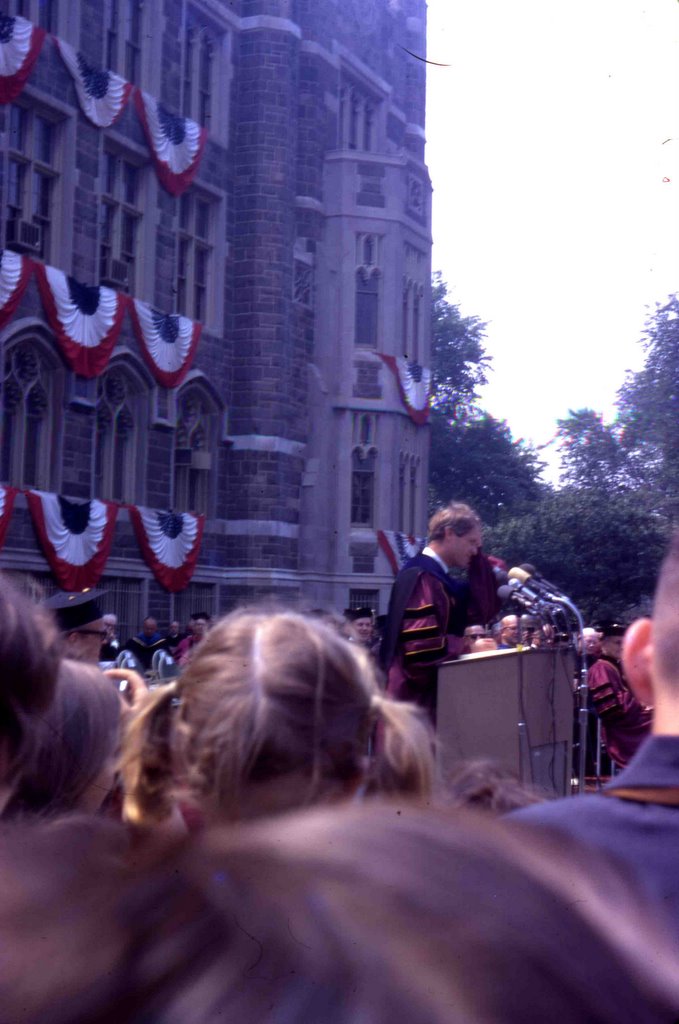 This is a picture of Robert Kennedy speaking at my graduation from Fordham University in 1967. Do I have to explain who he is? The younger brother of President John Kennedy, he served as Attorney General, then became Senator from New York. He was running for president in 1998 when he was assassinated June 5, ten days before my wedding to Chris Hawkins. I remember I had a final wedding dress fitting the day after the assassination, and I was in tears most of the time.
In the midst of a heated debate between Uncle Ken and the younger generation, I posted this account of my political evolution. I would love to hear everyone else's stories.
My first specific political memory centered around the duck and cover, hide under our desks, exercises that were a regular feature of my early school life from age 5 on. I knew enough about nuclear war to be terrified. We lived near to an air force base and I used to go out to the backyard, look up at the planes, and try to determine if they were American or Russian. I remember getting a book out of the library on aircraft identification. When I heard Joseph Stalin died, I remember asking if that meant no one would drop bombs on us.
In 1954 I had a severe case of the measles and Grandma Nolan came to help nurse me. She was listening to the Joseph McCarthy army hearings. Hatred of McCarthy's voice
might have shaped my entire political development. The other determining force was my obsession with John F. Kennedy. I first took an interest in political conventions in 1956, when I was 11. Kennedy made a brief try for the vice presidential nomination, and my mom mentioned he was Catholic, that there had never been a Catholic president. From 1956 to 1963, I read everything I could about Kennedy. When I was 15 I did volunteer work for his presidential campaign.
In high school we had political debates to imitate the famous Kennedy/Nixon debates and I represented Kennedy. What he believed in, I believed in. Gradually I moved to the left of his pragmatic liberalism. Certainly Kennedy was responsible for my decision to major in political science in college.
I cannot precisely date my interest in and commitment to civil rights. When I was a freshman, I joined my college's Interracial Understanding Group. I was envious of those college students who have the affluence to spend the summer down south registering voters and didn't have to worry about money to pay their tuition. Kennedy's assassination, occurring in the fall of my freshman year in college, devastated me. I felt like there had been a death in my immediate family. I quickly translated my political allegiance to Bobby Kennedy.
Gradually during college I became a pacifist. Opposition to the Vietnam War right from the beginning was the catalyst. My husband to be, Chris, applied for conscientious objector status and was willing to face jail rather than be inducted. We became very active in the Catholic Peace Fellowship, the Fellowship of Reconciliation, and the War Resister's League, all pacifist organizations. We went on several anti-war demonstrations both in New York and Washington. I briefly attended Stanford University where resistance to the war was at its height. Almost every afternoon, David Harris, Joan Baez's future husband, spoke out eloquently against the war.
My first job after Stanford was as an assistant to Victor Riesel, a labor columnist, who had been blinded by acid thrown in his face by the mob who controlled the waterfront he was exposing. One of my assigments was to read the AP ticker to him every day, clip articles in all the newspapers, labor papers. This was in 1968, when King and Kennedy were assassinated, when anti-war protect was at its height.
Subscribe to:
Posts (Atom)