Friday, February 6, 2009

New York City

Rainbow

I am jealous when I read accounts of OS friends meeting in California or DC for the inauguration. I am in Manhattan 3 days a week. there 3 days a Anyone who is interested in getting together in NYC, please send me a message.

I have no sense of how many OS contributors live anywhere near New York City or Long Island.

Monday, December 8, 2008

Mom's Gravesite- Mary Nolan

Both my parents are buried a Calverton, a military cemetery, on Eastern Long Island. My dad was a World War II veteran. When I was at Calverton for my aunt's funeral, I visited my mom's and dad's graves. I was perturbed to see mom's inscribed as Mary Nolan, because I had misremembered that she wanted Mary Nolan Koch.


I hunted through her correspondence and found the following letter sent to the Veterans Administration in Washington, a year after my father's death:

Feb. 5, 1988
Dear Sir,

On May 11, 1987, my husband, Joseph J. Koch, an Army veteran of World War II, was buried in the Calverton National Cemetery on Long Island, NY, gravesite 8179.

It is my understanding that gravesite 8180 has been reserved for me, his wife. When I recently visited the cemetery I was disturbed to note that the wives of veterans were only identified by their first name. To me that is sex discrimination.

Although I accepted my husband's name at marriage, I still consider myself as Mary Nolan and would wish to be so identified on a name plaque making my grave. Is there any reason why your policy could not be updated?

Yours truly,
Mary Nolan Koch

Subsequent correspondence showed the VA changed their policy and accepted her wishes. I feel rather sheepish about my first reaction. Bravo, Mary Nolan, a feminist ahead of her time! We were allowed to add an additional line, so we added mother, teacher, activist.

Family decisions on maiden names fascinate me. After much inner turmoil, I took my husband's name when I married in 1968. It was an English name; Koch lent itself to too many embarrassing mispronunciations. When I went back to school and work in 1987, I reverted to my maiden name. My master's degrees in library science and social work are under Koch.

Partly to disassociate myself from my past indiscretions, I took my new husband's name when I remarried in 2001. Now I use both names. Vanessa, Elizabeth, and Patricia surprised me by us by taking their husbands' names. Katherine, who kept  Hawkins, had the theory that the most Waspish names trumps, but Patricia's decision undermines that theory.  My nieces seem to have followed Katherine.

Three of my sisters-in-law kept the maiden names One brother and his former wife made up a new name that combined elements of both their names. I have met people who have used their mother's maiden name, rather than the name of the father who deserted them.

What did you or your spouse decide? What do you anticipate your daughters will do?

Friday, October 24, 2008

What Is Your Birth Order?

To Only Children: Being the oldest child dooms you to the responsibility chip, whether you have no siblings or 7. Until both your parents die, you are being parented by people who have no clue what they are doing. They get better with younger children, but they don't know how to parent a 25 year old, a 40 year old, a 55 year old anymore than they knew how to parent an infant or toddler. Their grandparenting skills are nonexistent. Children raise their parents to be grownups. Being outnumbered makes the job more challenging and stimulating, but you are always up to it.


MaryJoRichardOct47bigsister
scan20030207_174202
scan20030207_174837mjmark

In the first picture, I am 2 1/2; Richard is one. In the second, I am 3 1/2,, Stephen is six months. In the third picture, I am 7; Peter is newborn. In the fourth picture, I am 12; Michael is 1. In the fifth photo, I was 13, Mark was 1 month.

Studying the pictures helps me clarify my family dynamics. Sibling closeness has mattered more to me than to my brothers. I try much harder to keep the family connected. Being both the oldest and the only girl seems central. I was my adult height when my two younger brothers were born; they were only 5 and 7 when I left home for college. I must have seemed a maternal figure to them. In some pictures I look like their young mother.

We did not grow up in the same family. My mother returned to school full-time when Mark was 5; when he was 7, she started teaching high school. Richard, Stephen, and I had had a stay-at-home mother until we went to college. Mark doesn't remember my mom staying at home full-time. My father retired before Brian finished college. Recently, my brother 11 years younger told me he felt abandoned when I left for college when he was 7. He confused me with my mom.

We have very different perceptions of our parents. Richard, Stephen,  and I remember our dad as a brilliant intellectual and mathematician; Michael and Mark  remember a frail old man who disappeared into Alzheimer's Disease. The three oldest remember our childhood perceptions of my mom as "just a housewife" who never went to college. My younger brothers remember her the way her obituary describes her: "teacher, activist, trailblazer."

With the death of my mom, Richard, 18 months younger, is my only collaborator for family history. Fortunately, Joe was too busy climbing on the roof as a kid to remember very much. I could write family fiction and convince everyone it is family history.

I struggled not to favor my first daughter Vanessa in  squabbles with her 3 sisters. Both her dad Chris and I were the oldest children of oldest children of oldest children--not the best recipe for marital harmony. Certainly Vanessa shows the same sense of responsibility for her younger siblings that I felt. Chris, Vanessa, and I llament that younger siblings are not sufficiently grateful to us, oldest, who fought all the battles necessary to whip parents into shape.

In my constant discussions with friends about baby spacing when my kids were young, I noticed that adult relationships with your siblings greatly influence you. If you love your sibs, you might think a brother or sister is the best gift you will give your kids. If you don't talk to your sib, you will feel guilty about the trauma you are inflicting on the oldest. As people only have two children, there will only be younger and older older. Middle children seem to have special gifts society will sorely lack. When I told 6 year old Elizabeth that I was pregnant with Patricia, she rejoiced, "Now I won't be the only middle child."

Faced with the challenge of caring for my mother during the last years of her life, my brothers and I had to confront and heal lifelong conflicts and misunderstandings. It is so easy to fall into childhood roles. My mom was always the family switchboard. We would call her, not each other; she would relay the news to everyone. I struggle very hard not to play the same role.

I adore my brothers and wish we saw each other much more often. We are scattered from Maine to North Carolina. My mother had five brothers as well. As a teenager, I used to reproach her, "Mom, how could you do this to me? You knew what it was like." My mom, a long-term care activist, used to begin her speeches, "I have lived with 12 men--long pause--only one of them intimately." Growing up with my brothers, I acquired a lifelong comfort around men. Daughters were a challenge; sons would have been easier. Taking care of my grandson revives many wonderful memories of my brothers as children.


Thursday, October 9, 2008

Growing Up with Five Brothers

My dad was an actuary; my mom was a housewife who became a history teacher and activist after I left home. I have 5 brothers, 18 months, 3 years, 7 years, 11 years, and 13 years younger. All married relatively young; one brother divorced and remarried. They have 6, 0, 2, 1, and 2 children respectively. Two are grandpas, one with 5 grandkids, the other with 2. There is a lawyer, a chemistry professor, a teacher, a nurse, and an accountant. They live in Maine, upstate NY, North Carolina, Westchester NY, and Long Island NY.

Taking care of my toddler grandson Nate three days a week, I have recaptured many memories of my brothers as small boys. Growing up, I was extremely close to my brothers; we spent most of our free time together. We loved the beach, ice skating, roller skating, tree climbing, summer vacations, backyard baseball, touch football, and badminton. We played endless ping pong and knock hockey games, card games, Monopoly, and Scrabble. We had the biggest backyard on the block, and our house was always the neighborhood hangout. We had a basketball hoop attached to the garage that was in use day and night. There were no girls on the block, so I always played with the guys. I was passionately interested in baseball, and my brothers used to challenge their friends to ask me a baseball question I couldn't answer.

Looking back, the siblings might have relied on each other too much. Richard, Stephen,  and I were not very social; each of us had one best friend and two good ones. We never hung out with a group of peers. We always had each other to play with, argue with, compete with. We always defended our siblings against our parents and against neighborhood bullies. Except for Bob (the 4th child), we never dated in high school.

Rationality, intellect, and academic achievement were the family values, and we all honored them. Competitiveness was subtly encouraged even though my mother would occasionally inveigh against it half-heartedly. Sarcasm and teasing were prevalent; the victim was expected to take the joke. Excessive emotion was scorned; I cried alone in my room. I still find it absolutely humiliating to cry in public and feel critical of women who do. Except for my parents' deaths, I have virtually no members of my brother's crying past 3 or 4. The possibility of my dad's crying was unimaginable. My mother, who had 5 brothers too, always choked back her tears.

We ere encouraged to rejoice in how different we were from most people in our working-class suburban town. We were the intellectuals. When working summers as mail carriers, Richard and Stephen reported that no other families seem to subscribe to the same magazines me read. My dad strongly encouraged us to think for ourselves and not care what other people (except each other) thought. He pointed that the most people were too preoccupied with their own problems to think much about you. My brothers might not be much use for discussing emotional issues, but for intellectually stimulating, challenging conversations, they are terrific.

My brothers can see each other for the first time in 6 months and spend the evening discussing politics, not their personal lives. My brothers insist that they don't have to talk to their siblings frequently to stay close. Each is certain he would come through in a crisis, and their track record is excellent.
We all seem very interested in what the others are doing, but as long as my mom was alive, my brothers would ask my mom instead of calling their brothers. Now I have moved in that family switchboard role.

We still influence each other tremendously. We very much want our siblings' approval. Andrew, the chemistry professor, has been very opinionated about the college and career choices of his nieces and nephews. I have been amused and touched by how each of my brothers checked out my daughters' prospective husbands. We freely borrow each other's expertise. I was worried that the family would scatter after my mom died, but we all have attended the second generation's numerous weddings and sibling milestone birthday parties.

There is now a younger generation; three of us are thriving as grandparents. My parents would have 3 great grandchildren, with 3 more on the way. Everyone adores the babies and showers them with attention and love.

We have always had a strong family identity--intelligent, independent, well-educated, critical, autonomous. Marrying a gorgeous bimbo was not an option for my brothers. When we get together, we all have a good time. We have the same sense of humor, vote for the same candidates, enjoy the same movies. We all take pride in the academic and career success of the second generation. I am aware to what extent this pride in intellectual achievement is a defense against social insecurity and sets us apart from other people. Thankfully, our children have not inherited that limitation.

Having 5 younger brothers has probably shaped me more than any other single influence. I like and sometimes actually understand men and invariably defend them to women. I loathe men-bashing. Until I became a mother, I was far more comfortable in a group of men than a group of women. I enjoyed being the only girl in my political science classes at Fordham, while I was miserable in a girls' Catholic college in freshman year.

I did not consciously want sons. I always told people my 4 girls were my reward for 5 brothers. I always wanted a sister and am sometimes envious of my daughters' closeness. But I love taking care of a grandson and talking to little boys in the playground.

Monday, August 11, 2008

Toward Evening

This is one of my favorite pictures of my Mom, taken in late 2002, about 18 months before she died. She is reading Towards Evening: Reflections on Aging, Illness, and the Soul's Union With God; rather incredibly, the author is Mary Hope. Here is the publisher description: "Constantly rushed by the urgent demands of home and workplace, we often long for a season of solitude--an uninterrupted time to rest, meditate, and pray. Author Mary Hope found this time in late middle age, when she began this journal as a 'memorandum in preparation for . . . the perfect union with God.' Her entries never minimize the pain, loneliness, and fear that accompany aging, yet her vision soars beyond life's trials to God's blessings in changed circumstances."

Mom coped with adversity by prayer and by reading and learning. In this picture, she is doing both. She probably read more books than anyone I have ever known. When I was working full-time in the library, she came over almost every afternoon to stay with my daughters Katherine and Patricia.  Every week she seemed to read every book I had taken out of the library. Only our love of our family brought us closer together than our love of reading.

When her casket was open during the wake, I placed in her hands a copy of Jane Austen's Pride and Prejudice that she had given her bored 12 year old daughter one hot summer afternoon. My love affair with Jane Austen has endured my entire life. As a history teacher, Mom shared wonderful books with the whole family. We both read unfailingly read what the other recommended. I can't say that of anyone else in my life. Our similarly furnished minds helped us overcome are very dissimilar temperaments.

--
Posted By Matriarch to Matriarch at 8/11/2008 01:19:00 PM

Tuesday, November 27, 2007

Sharing a Room

Emily at Wheels on the Bus had an excellent post today on children's sharing rooms. Since I had a 2-bedroom apartment, a 3-bedroom apartment, and then a 3-bedroom house, my 4 daughters always shared rooms until the older ones went to college and shared rooms with absolute strangers.

Growing up, I was the only girl with 5 younger brothers; from the time I was 7, I had my own room. Before that, I shared a bedroom with my 2 younger brothers. I always wanted a sister, and I would have been happy to share a room with her. I always had roommates in college and in my first Manhattan apartments before I got married. My husband came from a family of 5 kids, and he always shared a room with his brother.

We took it for granted that our kids would share bedrooms. Originally we planned to stay in a New York City apartment, and only millionaires have a big enough apartment to give each of 4 children their own room. In no way did we ever feel we were depriving our kids because they didn't have their own rooms. In our 3-bedroom Manhattan apartment, 3 of them decided to sleep in the same bedroom, so they could use the extra bedroom as a playroom.

Getting the baby out of our bedroom was much easier because she looked forward to sharing a room with her sisters. Sharing bedrooms made bedtime easier all through early childhood.
I suspect my girls are closer because of their enforced togetherness. Sure there were conflicts, especially over cleaning rooms. I do recall my second child putting a strip of duct tape down the center of the room to establish cleaning responsibilities. Possibly they played more outside their bedrooms since they had less room.

Sharing rooms is excellent preparation for college. My kids always had roommates in college in dorm rooms much smaller than the usual bedroom. At Yale, one year, they had to share bunkbeds. In major US cities, most people share apartments for economic reasons.

I am 62. I only had my own room for 16 years--11 years of my childhood and 5 years between marriages. I have never felt deprived:)

Monday, November 19, 2007

Gardening


Gardening is in my blood. My grandparents had World War II victory gardens. My parents had a big backyard, about a third of an acre. My dad was a vegetable gardener, my mom grew flowers. Neither of them were great cooks, so I don't remember specific family recipes. What I remember are delicious fresh vegetables--tomatoes, string beans, corn, zucchini, broccoli, lettuce. No tomatoes or corn have ever tasted as good. They had wonderful blueberries bushes, which supplied enough berries to freeze for winter cereal. Before my mom went back to college, she canned tomatoes.

Gardening was the perfect way for my dad to unwind from his actuarial job and his long railroad commute into Manhattan. I remember his encouraging us to start our own little gardens. I remember helping him plant strawberries. I remember picking off Japanese beetles from the rose bushes and putting them in a jar of something that killed them. The garden was the best place for long talks with dad, away from the noise of too many brothers in a too small house.

After we moved to Long Island in 1983, I slowly became a gardener. I am erratic. I like to garden in the spring and fall before the summer heat drains my energy and motivation. I plant more than I weed. I usually grow herbs, tomatoes, cucumbers, zucchini, and eggplant. We have lots of perennials in the front yard; zinnias seem the ideal summer annual. Pruning and cutting the grass was an ideal way to deal with my anger in the years when my first marriage was dying. Visiting the garden first thing in the morning energizes me. Weeding is good for depression.

Since I became a grandmother, nurturing my grandson has replaced gardening. I look forward to introducing Michael to gardening when he is two and telling him stories about the great-grandparents he never met.

Monday, November 12, 2007

Marie's Childhood Memories

A few years before she died, my mom emailed some childhood memories, particularly about her dad.

As the oldest of my parent’s children I should share a few memories. My dad was very special for me. He took me everywhere with him since he liked to go for drives in the car, and not everyone wanted to go. I always asked if we would stop for food along the way, and he almost always obliged. However we did go on family trips. Once I remember going to Montreal. We always went out on Long Island in the summer, renting a bungalow usually for a month. In fact he wanted to buy a place but my mom was reluctant. Remember, there were very few amenities then, just old fashioned ice boxes and poor stoves. He would commute to the city often and come out on weekends.

One summer he when I was 12 I want to camp out there. I remember getting a letter telling me that he bought a book that even I couldn’t finish in one night - GONE WITH THE WIND - He knew that I sneaked into the bathroom at night to read after I was supposed to be in bed for the night. His law office in N.Y. was just across from City Hall and he often took me there when there was going to be a parade to welcome a celebrity to City Hall. I vaguely remember when I was a young kid going to see Lindberg’s celebration in 1927.

My dad was a lawyer who took pity on people who couldn’t afford to pay much. During the depression he had many clients who couldn’t pay him. When he died my mom found a file cabinet filled with unpaid bills from people he had helped. Fortunately, he did have people who paid so we were not too destitute during the 30’s. He was a Democrat and was a Roosevelt man, but I remember his coming home one day proclaiming ,“ He closed the banks.” As a family we talked politics. My parents supported FDR and his New Deal. That is probably the reason why I became an FDR supporter . In fact I cast my first vote for President for Roosevelt.

Unfortunately , long before doctors had the modern medicines that control high blood pressure , my dad had very high blood pressure which caused him many health problems During the last years of his life he was in the hospital many times. My mom was 12 years younger than my dad and still in her child bearing yearsAround the time each of my youngest brothers was born she also had a sick husband to care for. Since I was in my teens I used to take care of them when she would be at the hospital

My dad died in January 1939 at age 52, leaving my mom a widow with 7 children at age 40, the youngest less than 2. Because my dad was an independent lawyer he had no pension; due to his health conditions he had been unable to get much insurance. My mom was left with limited income except for the low rent from some old houses my dad owned in Brooklyn. My older half-brother Jim was in law school at this point and I was entering my senior year at high school, expecting to go to college when I graduated. I remember well my father’s brother Bill saying to my mom: “Well you’re lucky, Mary is a girl so she doesn’t need to go to college." I remember thinking maybe not now but certainly some day.”

Joe Describes His Courtship

He did have a secret weapon. His job had been writing letters under constricting rules. He now could write letters without rul3s. She claims it was all platonic yet her first letter to him was a sixteen-page affair. Looking back he is smiling at the strategy of the salutation of his letter. First it was a proper Dear Mary--it’s possible to write the same two words so they are less proper but more warm. She should have realized what his plans were right from the very beginning. The first thing he did was change her name,, he first name that is. How could he ever have written letters beginning Dear Marie.

Three months of seeing her, three months of exchanging letters and she was sure too. A little later--less than a year after they first met, it was properly formalized. She got a ring (It was not in a car; it was outside on the sidewalk in front of her house). The ratio was changed. One kiss in three months to how many kisses in two weeks? Not enough, there will never be enough. His heart was just too full--that time was a blur to him. Did it happen to her as it did to him? There was no beginning. It just always was. Just two he and she.

Of course they were going to be engaged for a long time, and it was a long time. Six months and twenty-six days. One could say he was respoinsible. Too much of his heart got into one of his letters and now slipped in. But she was more direct and she knew her hussyness. She met his train and before they got home it was all decided. And then for a week they didn’t see each other, well hardly at all. A girl has a lot to do before here wedding. Some girls take months and months. This girl did it all in a week. Besides he not knowing that (not clear)

Married on Monday. What plain words. Rainbow isn’t a fancy word either. Nor sunrise,nor moonlight. Love and sacrement--a sacrament of love. For this cause shall a man leave father and mother and shall cleave to his wife, and they two shall be in one flesh. Therefore now they are not two but one flesh.”

Sunday, November 11, 2007

Wartime Love Letters


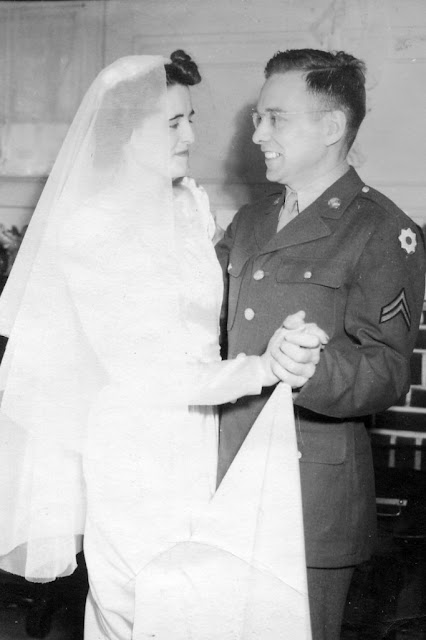
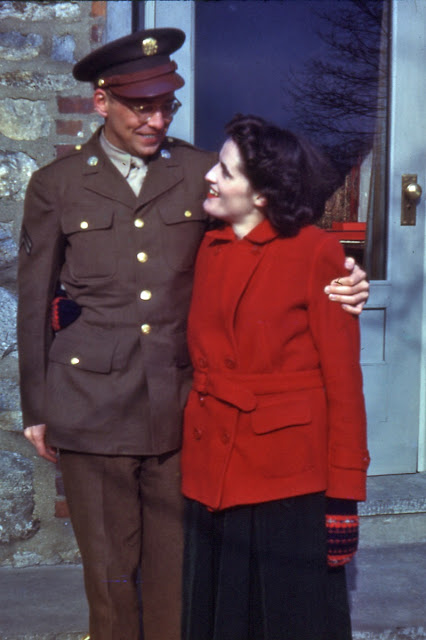
Mary and Joe, March 6, 1944; honeymoon

For Remembrance Day, Mad Hatter published a fascinating post about boxes of wartime letters she found when remodeling her old house. Her post has special resonance for me because I have 20 plastic boxes full of letters my parents wrote from November 1942, when my dad was drafted, until February 1946, when he came home from France and saw me for the first time. I keep postponing doing something with themt. I started a blog of the letters, Mary and Joe: World War II Love Story, but I haven't kept it up. My father particularly was a wonderful writer, who never wrote anything but these letters. Mad Hatter inspired me to go back to that project.

My daughter Rose wrote this about the wartime letters several years ago. She included excerpts from the letters that I am not including here.
In my grandmother's house, past a stone Mexican statue named Harry, up the front stairs and to the right there is a bedroom. In this bedroom there are a pea green carpet, a bed with yellow and orange flowered sheets, and a cracked blue dresser. This dresser, unlike every other bureau and closet in this house, does not contain any seventies-style ties, old scarves, or early feminist t-shirts. Instead every drawer is filled with letters.

Joe lived in Jamaica, Queens, with his parents and six younger sisters and brothers. His college yearbook said of him, "Even his own brilliance could not fathom the enigma that is Joe." Mary lived in Queens Village. She was the second child, and the oldest girl, in a family of seven. Her high school yearbook described her as, "Sincerity coupled with bubbling vivacity, scholastic excellence with literary talents, athletic prowess, sparkling wit." She would not have a college yearbook until many years later, because her father had died without much life insurance when she was seventeen years old. Her father's brother squeezed together the money for her older brother to continue school at St. John's, but Mary was just a girl.

Mary and Joe had met the summer of 1942, on a raft at Loon Lake in the Adirondacks. He was 28, she was 21. A week later, back in Queens, he took her to see Bambi. They saw each other often in the three months after Bambi became Prince of the forest, and before Joe was drafted. He kissed her for the first time on the day he left for the army.

They will get engaged the night before her 22nd birthday in August 1943 and will marry the next March. The wedding will not be fancy, since it was planned in about four days and no one had much money anyway. The reception will be in Mary's backyard. Joe will go off to war in Europe, though his bad vision will ensure that he never faces combat. They will have their first child while he is away. There will be short letters to Baby Mary Jo, my mother, enclosed with the longer ones to Mary. Then in 1946, when Mary Jo is eight months old, Joe will finally come home and the letters will end.

They will have five more children, and the children will have fourteen kids of their own. Joe will die of Alzheimer's disease in May of 1987. Mary will become a lobbyist and counselor for victims of the disease and their families. She will become even more involved with her church, and even more of a rock for her distressingly heathen children and grandchildren. Mary will die in April 2004 of Progressive Supranuclear Palsy.

My grandparents' generation has been called "The Greatest Generation." They survived the depression, they fought Hitler. Yes, they did, but many of them also contributed to horrible racial injustice, and a few of them dropped the bomb. I suppose that talking about our parents' and grandparents' moral superiority is an improvement over not trusting them because they're over forty, but it's not much of an improvement. It would be far more honest to say that they did some very good things, and some very bad things. They had fewer toys, and certainly they wrote better love letters, but they were more or less just like us.

To put it another way, generation schmeneration. I'm not going to even try to judge. Instead I will sit here and read these letters. I will learn that my mother's mother is more than the grandma who babysat for us almost every week for ten years, and who is always inappropriately freezing things. I will learn that my mother's father was far more than the sick, confused old man I remember.

What We Wanted for Christmas

How did we know what we wanted for Christmas in the days before television, glossy newspaper and magazine advertisements? The Sears Christmas Wish Book was our bible. After it came in early November, my mom used to hide it for a few weeks, so we didn't have months to want things she couldn't afford to give us. I don't recall regular visits to department stores, though we probably did visit Santa Claus occasionally.

We had more generic requests--bikes, trains, truck, dolls, chemistry sets, tinker toys--than kids do today. I recall being thrilled with a cake baking set. We didn't long for specific brands, colors, sizes. Our presents did not require batteries. We were aware that mom and dad were not rich.

But my memory could be playing tricks on me. Perhaps I spent hours gazing over the Sears catalog and coming up with a 25-item list. In my old age, I have learned to mistrust memories that compare me favorably to younger generations. When my daughter Rose was 5, she said, "anything Santa wants to bring me for Christmas is fine with me." I doubt my brothers and I would have been so unmaterialistic.

Saturday, October 6, 2007

Dependence and Aging Parents


In response to my post on accepting dependence, Eve asked me: "What advice would you give to those of us with older parents who are soon to enter into a dependency stage?"

I wrestle with these questions for myself. I see my cousins struggle with the same issues with my aunts and uncles. My mother was incredibly healthy and active until she fractured her pelvis on a trip to Israel. In fact, she walked around Israel for a week with a fractured pelvis. I suspect only my father could tell her what to do; I often wished my dad were still alive to cope with her destructive decisions. Mom thought that her mom had taken a defeatist attitude toward her arthritis, taken to her chair, and given up her formerly active life. She was never going to be like her mom; exercise, yoga, great diet would all prevent that. But my grandmother lived four years longer, and taking care of her was relatively easy. She remained the loving, wise grandmother who was a great listener; she lived to know 23 great grandchildren.

In her eloquent tribute to my mom, my daughter Rose points out she was always moving. My mom never seemed anxious or depressed; she coped with negative feelings by activity. As her health and life fell apart very quickly, she wasn't comfortable about expressing her fears or grief. I often wondered if she had adequately mourned her little sister who died when mom was 5, her father who died when she was 17.

If my mom had been more cautious, she might still be alive to see six grandchildren married and meet three great-grandchildren. Anne, my oldest daughter, has told me dozens of times in the five months of her son Nate's life how much she misses Grandma. I used to tell my mom, "Mom, so many of your grandkids are just on the cusp of marriage and parenthood. Isn't seeing Mommy Anne worth letting us take care of you?"

Our generation is being encouraged to think we can defeat aging. The US can't cope with dependency at the beginning or end of life. Letting people take care of you can be the most loving gift you can give them. I recommend the superb blog, Time Goes By--What It's Really Like to Get Older by Ronni Bennett. If your parents are aging, encourage them to read it and discuss with you the many issues she raises. All of us constantly struggle with being able to ask for and accept help. I recently sprained my knee, and I hate to ask my husband for the help he is happy to give.

Even though it was challenging, I have always been glad I was able to welcome my mom into my home and give back a small part of what she had given to her family, her friends, the world. My then new husband Paul was wonderful with her. Since he hadn't known the super Mary, he could love the reduced Mary without mourning what was no longer there. People used to assume Paul was mom's son; mom get confused explaining she wasn't English.

Please share your thoughts and experiences with this.

Thursday, October 4, 2007

Book Worm

This picture was taken at my grandmother's house, February 1, 1947, the day before my brother Richard was born. I was 18 months old. her kitten. In my baby book my mom wrote: "A book worm--she loved all books. At 2 years her favorites were Dumbo, Children's Garden of Verses, Alice in Wonderland. Was always eager for Cinderella, Goldilocks, etc." Under my favorite books, she listed Daddy's and Uncle George's yearbook, Mother Goose, all magazines, ABC book. Later I wrote in Nancy Drew.

My interest in my dad's yearbook indicated that I was fascinated in family history and dynamics from infancy.

Are book worms made or born? Mom and Dad were consummate book worms. People who say they don't have time to read baffle me. How do they stay sane? How do they escape? How do they figure out stuff? I have always coped with problems, illness, tragedy by going to the library. Reading blogs, I go to my library site to reserve books that someone has highly recommended.

My first library card seemed magical. I vividly remember my awe when I realized that card was a passport to the whole world. My sister-in-law once paid me the supreme compliment: "Your idea of domesticity is putting your books in alphabetical order."

Reading always took precedence over housework in my family. I was enchanted when three -year-old Elizabeth crooned to her doll: "Don't cry baby; mommy will read to you." My mom introduced me to my favorite author, Jane Austen, when I was 12. Jane Austen introduced me to my second husband.. I made a Austen literary allusion on an internet support group, and Andy made a witty comeback. I was instantly smitten. Little did I know how much reading about green cards awaited me.

--
Posted By Mary Jo Graves to Matriarch at 10/04/2007 10:39:00 AM

Wednesday, October 3, 2007

Would Size Order Have Helped?


The last picture of the Koch siblings was taken at my daughter Anne's wedding two years ago. I wonder what ordering--height, weight, age, income, or maturity--would have kept Andrew and Bob in check. In every picture at least one of them is clowning around. Everyone is behaving better in 1956, 1958,1961 and 1967. In the 1961 picture of Joe's graduation, Andrew was made to kneel down so he would not be obvious he was taller. Each time a brother surpassed me in height there was much rejoicing by all of them. I've always wanted to be taller; I still hate it that my brothers tower over me. I am relieved that Anne is shorter, Michelle is my height, and Rose and Carolyn aren't that much taller.

Monday, June 18, 2007

Reading

Hawkins Sisters' Books

When Vanessa was born, my parents brought children's books on their first visit. I have always believed that babies need books from birth. My years as a children's librarian deepened my love of children's books. Vanessa and John have read to Nate from the beginning.


Wednesday, June 13, 2007

Grandma Mary

My mother was only 52 when my oldest Anne was born. I had to wait until 62 to become a grandmother. Look how young she looks. She was an incredibly energetic grandmother, the kind who takes their grandchildren to Europe. Teenage Anne once commented: "I could even visualize you and dad dying, but grandma is immortal." Sadly, she didn't live to meet her two great grandsons and her great-daughter. By year's end, there will be six great grandchildren.

The downside of women's having children after they are settled in their careers is that their parents are older. Their children might not be grown when the parents have to confront the dilemmas of elder care. My grandmother was 47 when I was born. She lived long enough to meet 23 great grandchildren. Of course, her children had their children much younger as well.

My mother, my aunts, and their friends had their children young, then went back to school and embarked on a new career in their forties. For the most part, they did well. My Aunt Rosemarie went to law school at age 40, and went on to be chief counsel to the president of Stonybrook University.

Becoming a Grandmother

My first grandchild Nate was born May 9. 2007 to my oldest daughter Vanessa.  Vanessa and her husband John live in New York City, only a 38-minute train ride away.

Because I am so close and because Vanessa has given me the incredible gift of welcoming my company, I have seen Nate almost every weekday since he was born, I have felt absolute joy getting to know him and watching my daughter and son-in-law blossom into wonderful parents.

Tuesday, April 10, 2007

Importance of Funerals

My godfather, Jim, who served on the USS Biloxi during World War II

I am in the process of transferring a blog from a former site. I wrote this in March 2004; I left it as is, so as not to detract from the immediacy of it.

I haven't written this week. My uncle/godfather died and I was busy with wakes, funerals, memories. When I was younger, I was freaked out by funerals. Now I welcome the opportunity to see aunts, uncles, cousins I see too rarely. My uncle was 87, had been sick for a long time. He died peacefully, telling his family he "was going to see his bride," his wife who died ten years ago. So his funeral was more a mellow celebration of his life, very different from the wrenching heartbreak of four years ago, when my 64-year-old uncle succumbed to a four-month battle with cancer. Uncle Jim's four children and twelve grandchildren were all there. I feel strongly that people should go to their grandparents', aunts' and uncles' funerals. Two of my cousins brought their four month and seven month babies, which added to the celebration of my uncle's life.

My cousin, Jim's oldest son, gave a touching eulogy. I particularly liked this: "I would argue that Dad's secret was that he knew how to like people. There may be someone in this world who has met my father and who does not like him. However, with absolulute certainty, I can tell you that there is no one, whom my father has met, in whom my father did not immediately see the good and with whom my father would not immediately share his humor....Everyone who came into his presence met a warm smiling face and a friendly voice, which comjunicated immediately that one was accepted and loved."

My uncle was a wonderful storyteller who loved telling jokes. My cousin concluded: "I hope God likes to listen to jokes." My mother died three weeks after her older brother. We wondered if she liked Jim's jokes that much! It was the last time her brothers, nieces, and nephews saw her. She was in good form, admiring the family babies, obviously happy to see everyone. If her family had missed seeing her that last time, they would have always regretted it.

Sunday, January 14, 2007

March 6, 1944


My mother's younger brother, Warren, then 10, describes the wedding:
All hell broke loose. This Koch guy was coming home on furlough, and was going to get hitched to my sister. It was Four Koch sisters riotously descended on our 220th Street home, seeking to turn it into a wedding palace - Agnes, Peggy, Mary and Jane! After them, D-Day was a letdown! In preparation for the great day, Frank, Ken and I, now nearly 10, 8 and 12, were sent out across the neighborhood on a foraging mission, a kind of loaves and fishes expedition, to find red ration coupons so there could be meat served at the wedding feast.

March 6th was a brilliantly sunny, crisp day, more spring than winter. At the wedding, my big shot Xavier brother Robert, with his fancy blue uniform and white gloves, got to give away the bride, subbing for Jim who was in the Pacific. At the 220th Street reception, I have a strong memory of being impressed that our pastor, Father Herchenroder, was actually standing in our backyard, in a black leather jacket, talking just like a regular person. After the reception, my sister took off somewhere with Corporal Koch, and we kids went across the street to the more serious business of shooting marbles.