Sunday, November 11, 2007

Wartime Love Letters


Mary and Joe, March 6, 1944; honeymoon

For Remembrance Day, Mad Hatter published a fascinating post about boxes of wartime letters she found when remodeling her old house. Her post has special resonance for me because I have 20 plastic boxes full of letters my parents wrote from November 1942, when my dad was drafted, until February 1946, when he came home from France and saw me for the first time. I keep postponing doing something with themt. I started a blog of the letters, Mary and Joe: World War II Love Story, but I haven't kept it up. My father particularly was a wonderful writer, who never wrote anything but these letters. Mad Hatter inspired me to go back to that project.

My daughter Rose wrote this about the wartime letters several years ago. She included excerpts from the letters that I am not including here.
In my grandmother's house, past a stone Mexican statue named Harry, up the front stairs and to the right there is a bedroom. In this bedroom there are a pea green carpet, a bed with yellow and orange flowered sheets, and a cracked blue dresser. This dresser, unlike every other bureau and closet in this house, does not contain any seventies-style ties, old scarves, or early feminist t-shirts. Instead every drawer is filled with letters.

Joe lived in Jamaica, Queens, with his parents and six younger sisters and brothers. His college yearbook said of him, "Even his own brilliance could not fathom the enigma that is Joe." Mary lived in Queens Village. She was the second child, and the oldest girl, in a family of seven. Her high school yearbook described her as, "Sincerity coupled with bubbling vivacity, scholastic excellence with literary talents, athletic prowess, sparkling wit." She would not have a college yearbook until many years later, because her father had died without much life insurance when she was seventeen years old. Her father's brother squeezed together the money for her older brother to continue school at St. John's, but Mary was just a girl.

Mary and Joe had met the summer of 1942, on a raft at Loon Lake in the Adirondacks. He was 28, she was 21. A week later, back in Queens, he took her to see Bambi. They saw each other often in the three months after Bambi became Prince of the forest, and before Joe was drafted. He kissed her for the first time on the day he left for the army.

They will get engaged the night before her 22nd birthday in August 1943 and will marry the next March. The wedding will not be fancy, since it was planned in about four days and no one had much money anyway. The reception will be in Mary's backyard. Joe will go off to war in Europe, though his bad vision will ensure that he never faces combat. They will have their first child while he is away. There will be short letters to Baby Mary Jo, my mother, enclosed with the longer ones to Mary. Then in 1946, when Mary Jo is eight months old, Joe will finally come home and the letters will end.

They will have five more children, and the children will have fourteen kids of their own. Joe will die of Alzheimer's disease in May of 1987. Mary will become a lobbyist and counselor for victims of the disease and their families. She will become even more involved with her church, and even more of a rock for her distressingly heathen children and grandchildren. Mary will die in April 2004 of Progressive Supranuclear Palsy.

My grandparents' generation has been called "The Greatest Generation." They survived the depression, they fought Hitler. Yes, they did, but many of them also contributed to horrible racial injustice, and a few of them dropped the bomb. I suppose that talking about our parents' and grandparents' moral superiority is an improvement over not trusting them because they're over forty, but it's not much of an improvement. It would be far more honest to say that they did some very good things, and some very bad things. They had fewer toys, and certainly they wrote better love letters, but they were more or less just like us.

To put it another way, generation schmeneration. I'm not going to even try to judge. Instead I will sit here and read these letters. I will learn that my mother's mother is more than the grandma who babysat for us almost every week for ten years, and who is always inappropriately freezing things. I will learn that my mother's father was far more than the sick, confused old man I remember.

What We Wanted for Christmas

How did we know what we wanted for Christmas in the days before television, glossy newspaper and magazine advertisements? The Sears Christmas Wish Book was our bible. After it came in early November, my mom used to hide it for a few weeks, so we didn't have months to want things she couldn't afford to give us. I don't recall regular visits to department stores, though we probably did visit Santa Claus occasionally.

We had more generic requests--bikes, trains, truck, dolls, chemistry sets, tinker toys--than kids do today. I recall being thrilled with a cake baking set. We didn't long for specific brands, colors, sizes. Our presents did not require batteries. We were aware that mom and dad were not rich.

But my memory could be playing tricks on me. Perhaps I spent hours gazing over the Sears catalog and coming up with a 25-item list. In my old age, I have learned to mistrust memories that compare me favorably to younger generations. When my daughter Rose was 5, she said, "anything Santa wants to bring me for Christmas is fine with me." I doubt my brothers and I would have been so unmaterialistic.

Saturday, October 6, 2007

Dependence and Aging Parents


In response to my post on accepting dependence, Eve asked me: "What advice would you give to those of us with older parents who are soon to enter into a dependency stage?"

I wrestle with these questions for myself. I see my cousins struggle with the same issues with my aunts and uncles. My mother was incredibly healthy and active until she fractured her pelvis on a trip to Israel. In fact, she walked around Israel for a week with a fractured pelvis. I suspect only my father could tell her what to do; I often wished my dad were still alive to cope with her destructive decisions. Mom thought that her mom had taken a defeatist attitude toward her arthritis, taken to her chair, and given up her formerly active life. She was never going to be like her mom; exercise, yoga, great diet would all prevent that. But my grandmother lived four years longer, and taking care of her was relatively easy. She remained the loving, wise grandmother who was a great listener; she lived to know 23 great grandchildren.

In her eloquent tribute to my mom, my daughter Rose points out she was always moving. My mom never seemed anxious or depressed; she coped with negative feelings by activity. As her health and life fell apart very quickly, she wasn't comfortable about expressing her fears or grief. I often wondered if she had adequately mourned her little sister who died when mom was 5, her father who died when she was 17.

If my mom had been more cautious, she might still be alive to see six grandchildren married and meet three great-grandchildren. Anne, my oldest daughter, has told me dozens of times in the five months of her son Nate's life how much she misses Grandma. I used to tell my mom, "Mom, so many of your grandkids are just on the cusp of marriage and parenthood. Isn't seeing Mommy Anne worth letting us take care of you?"

Our generation is being encouraged to think we can defeat aging. The US can't cope with dependency at the beginning or end of life. Letting people take care of you can be the most loving gift you can give them. I recommend the superb blog, Time Goes By--What It's Really Like to Get Older by Ronni Bennett. If your parents are aging, encourage them to read it and discuss with you the many issues she raises. All of us constantly struggle with being able to ask for and accept help. I recently sprained my knee, and I hate to ask my husband for the help he is happy to give.

Even though it was challenging, I have always been glad I was able to welcome my mom into my home and give back a small part of what she had given to her family, her friends, the world. My then new husband Paul was wonderful with her. Since he hadn't known the super Mary, he could love the reduced Mary without mourning what was no longer there. People used to assume Paul was mom's son; mom get confused explaining she wasn't English.

Please share your thoughts and experiences with this.

Thursday, October 4, 2007

Book Worm

This picture was taken at my grandmother's house, February 1, 1947, the day before my brother Richard was born. I was 18 months old. her kitten. In my baby book my mom wrote: "A book worm--she loved all books. At 2 years her favorites were Dumbo, Children's Garden of Verses, Alice in Wonderland. Was always eager for Cinderella, Goldilocks, etc." Under my favorite books, she listed Daddy's and Uncle George's yearbook, Mother Goose, all magazines, ABC book. Later I wrote in Nancy Drew.

My interest in my dad's yearbook indicated that I was fascinated in family history and dynamics from infancy.

Are book worms made or born? Mom and Dad were consummate book worms. People who say they don't have time to read baffle me. How do they stay sane? How do they escape? How do they figure out stuff? I have always coped with problems, illness, tragedy by going to the library. Reading blogs, I go to my library site to reserve books that someone has highly recommended.

My first library card seemed magical. I vividly remember my awe when I realized that card was a passport to the whole world. My sister-in-law once paid me the supreme compliment: "Your idea of domesticity is putting your books in alphabetical order."

Reading always took precedence over housework in my family. I was enchanted when three -year-old Elizabeth crooned to her doll: "Don't cry baby; mommy will read to you." My mom introduced me to my favorite author, Jane Austen, when I was 12. Jane Austen introduced me to my second husband.. I made a Austen literary allusion on an internet support group, and Andy made a witty comeback. I was instantly smitten. Little did I know how much reading about green cards awaited me.

--
Posted By Mary Jo Graves to Matriarch at 10/04/2007 10:39:00 AM

Wednesday, October 3, 2007

Would Size Order Have Helped?


The last picture of the Koch siblings was taken at my daughter Anne's wedding two years ago. I wonder what ordering--height, weight, age, income, or maturity--would have kept Andrew and Bob in check. In every picture at least one of them is clowning around. Everyone is behaving better in 1956, 1958,1961 and 1967. In the 1961 picture of Joe's graduation, Andrew was made to kneel down so he would not be obvious he was taller. Each time a brother surpassed me in height there was much rejoicing by all of them. I've always wanted to be taller; I still hate it that my brothers tower over me. I am relieved that Anne is shorter, Michelle is my height, and Rose and Carolyn aren't that much taller.

Monday, June 18, 2007

Reading

Hawkins Sisters' Books

When Vanessa was born, my parents brought children's books on their first visit. I have always believed that babies need books from birth. My years as a children's librarian deepened my love of children's books. Vanessa and John have read to Nate from the beginning.


Wednesday, June 13, 2007

Grandma Mary

My mother was only 52 when my oldest Anne was born. I had to wait until 62 to become a grandmother. Look how young she looks. She was an incredibly energetic grandmother, the kind who takes their grandchildren to Europe. Teenage Anne once commented: "I could even visualize you and dad dying, but grandma is immortal." Sadly, she didn't live to meet her two great grandsons and her great-daughter. By year's end, there will be six great grandchildren.

The downside of women's having children after they are settled in their careers is that their parents are older. Their children might not be grown when the parents have to confront the dilemmas of elder care. My grandmother was 47 when I was born. She lived long enough to meet 23 great grandchildren. Of course, her children had their children much younger as well.

My mother, my aunts, and their friends had their children young, then went back to school and embarked on a new career in their forties. For the most part, they did well. My Aunt Rosemarie went to law school at age 40, and went on to be chief counsel to the president of Stonybrook University.

Becoming a Grandmother

My first grandchild Nate was born May 9. 2007 to my oldest daughter Vanessa.  Vanessa and her husband John live in New York City, only a 38-minute train ride away.

Because I am so close and because Vanessa has given me the incredible gift of welcoming my company, I have seen Nate almost every weekday since he was born, I have felt absolute joy getting to know him and watching my daughter and son-in-law blossom into wonderful parents.

Tuesday, April 10, 2007

Importance of Funerals

My godfather, Jim, who served on the USS Biloxi during World War II

I am in the process of transferring a blog from a former site. I wrote this in March 2004; I left it as is, so as not to detract from the immediacy of it.

I haven't written this week. My uncle/godfather died and I was busy with wakes, funerals, memories. When I was younger, I was freaked out by funerals. Now I welcome the opportunity to see aunts, uncles, cousins I see too rarely. My uncle was 87, had been sick for a long time. He died peacefully, telling his family he "was going to see his bride," his wife who died ten years ago. So his funeral was more a mellow celebration of his life, very different from the wrenching heartbreak of four years ago, when my 64-year-old uncle succumbed to a four-month battle with cancer. Uncle Jim's four children and twelve grandchildren were all there. I feel strongly that people should go to their grandparents', aunts' and uncles' funerals. Two of my cousins brought their four month and seven month babies, which added to the celebration of my uncle's life.

My cousin, Jim's oldest son, gave a touching eulogy. I particularly liked this: "I would argue that Dad's secret was that he knew how to like people. There may be someone in this world who has met my father and who does not like him. However, with absolulute certainty, I can tell you that there is no one, whom my father has met, in whom my father did not immediately see the good and with whom my father would not immediately share his humor....Everyone who came into his presence met a warm smiling face and a friendly voice, which comjunicated immediately that one was accepted and loved."

My uncle was a wonderful storyteller who loved telling jokes. My cousin concluded: "I hope God likes to listen to jokes." My mother died three weeks after her older brother. We wondered if she liked Jim's jokes that much! It was the last time her brothers, nieces, and nephews saw her. She was in good form, admiring the family babies, obviously happy to see everyone. If her family had missed seeing her that last time, they would have always regretted it.

Sunday, January 14, 2007

March 6, 1944


My mother's younger brother, Warren, then 10, describes the wedding:
All hell broke loose. This Koch guy was coming home on furlough, and was going to get hitched to my sister. It was Four Koch sisters riotously descended on our 220th Street home, seeking to turn it into a wedding palace - Agnes, Peggy, Mary and Jane! After them, D-Day was a letdown! In preparation for the great day, Frank, Ken and I, now nearly 10, 8 and 12, were sent out across the neighborhood on a foraging mission, a kind of loaves and fishes expedition, to find red ration coupons so there could be meat served at the wedding feast.

March 6th was a brilliantly sunny, crisp day, more spring than winter. At the wedding, my big shot Xavier brother Robert, with his fancy blue uniform and white gloves, got to give away the bride, subbing for Jim who was in the Pacific. At the 220th Street reception, I have a strong memory of being impressed that our pastor, Father Herchenroder, was actually standing in our backyard, in a black leather jacket, talking just like a regular person. After the reception, my sister took off somewhere with Corporal Koch, and we kids went across the street to the more serious business of shooting marbles.

Monday, December 11, 2006

Pregnant? November 1944

Nov. 1

"Darling I am quite convinced that we're going to be proud parents in July. Four days late and still no sign of my period. (Grandma, like me, was regular as clockwork.) I'm still waiting two weeks though before I'll be completely convinced. Oh hon, each day I feel more certain that Our Lady has given us another wonderful favor. This is the bestest favor of all--a child of our very own.

Joe, I am sure it's true. I certainly haven't been feeling exactly normal. I can't say that I've really been nauseous, but I seem to have something very close to it. Maybe that accounts for my steady tired feeling too. All in all though, I feel fine, and I'm sure I'll have a normal pregnancy. Hon, it seems funny to talk about my being pregnant. Isn't it super?"

Nov. 10, 1944

"I told my mother she's going to be a grandmother and she wasn't even the least bit surprised. She said that it's really not necessary to go to the doctors until the end of the second month because he couldn't tell my anything until then anyway. ...It's fun being able to talk about it to mom though."

Nov. 14, 1944
"I haven't starting eating crackers in bed because I really haven't been too nauseous in the early morning. I usually feel worse about 10 or 11 o'clock.

Our secret is still a three-way secret although I don't know how I held back last night . Ginnie and Peg apparently thought that nothing happened because I didn't say anything. They were teasing me that I'd have my last chance to make good when you get your 5-day pass. Ha, Ha, little do they know that our baby is a month old already."

December 1944--Two Months Pregnant

My lucky steak ended today because I've been feeling sickish all day. I hate to miss Communion on Sunday, but I did this morning....After all my talking last night, I didn't go to Wisdom (her alma mater) this afternoon anyway. I was afraid I might get sick on the bus or something. So I spent most of the afternoon sleeping and about 5 I got up feeling much better.

Let's buy the baby something for Christmas. If you're lucky enough to get a 5 day pass, we can go shopping next Saturday. Otherwise I'll buy a baby dress or sweater or something myself. After all, Mary-Jo should have a hope chest too...

No, I didn't do any talking in the doctor's office--I just listened. You didn't think it possible, did you? Remember my telling you I could be silent and subdued some times? No, darling, doctors never embarrass me. They're so impersonal anyway. Most of the time you are covered with a sheet anyway. It's silly to get excited about going to the doctor's. That's just part of having a baby....

...Being a mother is just about the best thing that could happen to anyone. Darling, I guess you feel the same way about being a father. Joe, I still can't believe it really. It seems too wonderful to be true.

November, 1944--Pregnancy

November 7, 1944

Dear, by this time you've had more mail from me, haven't you? You should know that things are pretty definite about our being parents next July. Isn't it super wonderful hon? Oh darling I'm so excited and happy I don't know that I can keep it a secret much longer. I want the whole world to know that I'm the luckiest girl in it 'cause I'm going to be a mommy. Joe darling, I love Mary-Jo's daddy awfully very much.

Very once in a while a baby Joe was mentioned.

Darling, I am so excited I doubt if I can keep it a secret much longer. I'll probably tell my mother soon and Peggy is likely it get it out of me at any time. Joe, I like having secrets with you. Dear, it's thrilling hearing my hubby say, "hello mommy."

November 8

Today I''m feeling quite chipper 'cause I talked with my husband last night. Dear, it was so exciting to share our secret. I like being a future mother awfully much. I love Mary-Jo's future daddy just millions of billions of times. I love you more than all the babies that were born this year. Just think hon, ours will be one of the babies who'll be born next year. Byrdie just told me before that Gladys Adams ( the secretary who married her boss, remember) is expecting a baby the end of April. I had all I could do to keep from telling her that Mary Koch is expecting a baby the beginning of July. It's really too soon to tell anyone yet though. I wonder how the doctor will figure. I understand that they estimate one week after the first day of your last period and then say it'll be nine months from then. Which means that he'd probably say sometime around July 8th. My guess is about the 15th though. I've decided I'll wait until the 26th of Nov., which would normally be my next period and then if nothing happens, I'll arrange to go to the doctor the following week. I think I'll call Dr. Schanno and ask him to recommend me to someone.

November 11, 1944--Mom to Dad

November 7, 1944

Dear, by this time you've had more mail from me, haven't you? You should know that things are pretty definite about our being parents next July. Isn't it super wonderful hon? Oh darling I'm so excited and happy I don't know that I can keep it a secret much longer. I want the whole world to know that I'm the luckiest girl in it 'cause I'm going to be a mommy. Joe darling, I love Mary-Jo's daddy awfully very much.

Very once in a while a baby Joe was mentioned.

Darling, I am so excited I doubt if I can keep it a secret much longer. I'll probably tell my mother soon and Peggy is likely it get it out of me at any time. Joe, I like having secrets with you. Dear, it's thrilling hearing my hubby say, "hello mommy."

November 8

Today I''m feeling quite chipper 'cause I talked with my husband last night. Dear, it was so exciting to share our secret. I like being a future mother awfully much. I love Mary-Jo's future daddy just millions of billions of times. I love ou more than all the babies that were born this year. Just think hon, ours will be one of the babies who'll be born next year. Byrdie just told me before that Gladys Adams ( the secretary who married her boss, remember) is expecting a baby the end of April. I had all I could do to keep from telling her that Mary Koch is expecting a baby the beginning of July. It's really too soon to tell anyone yet though. I wonder how the doctor will figure. I understand that they estimate one week after the first day of your last period and then say it'll be nine months from then. Which means that he'd probably say sometime around July 8th. My guess is about the 15th though. I've decided I'll wait until the 26th of Nov., which would normally be my next period and then if nothing happens, I'll arrange to go to the doctor the following week. I think I'll call Dr. Schanno and ask him to recommend me to someone.

November 7 and 8, 1944--Mary to Joe

November 7, 1944

Dear, by this time you've had more mail from me, haven't you? You should know that things are pretty definite about our being parents next July. Isn't it super wonderful hon? Oh darling I'm so excited and happy I don't know that I can keep it a secret much longer. I want the whole world to know that I'm the luckiest girl in it 'cause I'm going to be a mommy. Joe darling, I love Mary-Jo's daddy awfully very much.

Very once in a while a baby Joe was mentioned.

Darling, I am so excited I doubt if I can keep it a secret much longer. I'll probably tell my mother soon and Peggy is likely it get it out of me at any time. Joe, I like having secrets with you. Dear, it's thrilling hearing my hubby say, "hello mommy."

November 8

Today I''m feeling quite chipper 'cause I talked with my husband last night. Dear, it was so exciting to share our secret. I like being a future mother awfully much. I love Mary-Jo's future daddy just millions of billions of times. I love ou more than all the babies that were born this year. Just think hon, ours will be one of the babies who'll be born next year. Byrdie just told me before that Gladys Adams ( the secretary who married her boss, remember) is expecting a baby the end of April. I had all I could do to keep from telling her that Mary Koch is expecting a baby the beginning of July. It's really too soon to tell anyone yet though. I wonder how the doctor will figure. I understand that they estimate one week after the first day of your last period and then say it'll be nine months from then. Which means that he'd probably say sometime around July 8th. My guess is about the 15th though. I've decided I'll wait until the 26th of Nov., which would normally be my next period and then if nothing happens, I'll arrange to go to the doctor the following week. I think I'll call Dr. Schanno and ask him to recommend me to someone.

She Aids Group That Aided Her

- A Newsday article reprinted by permission, Newsday, Inc.
Copyright, 1995

When her husband, Joseph, was diagnosed with Alzheimer's in 1985, Mary Koch did what most wives-turned-caregivers would do. She joined an organization that offered support groups and advice. In her case, the Long Island chapter of the Alzheimer's Association, with an office in Patchogue.

After her husband died in 1987, Koch,now 73, remained an active supporter. This dedication has led her up the volunteer ladder to her present position as the chapter's legislativeadvocate. She also leads a support group in Elmont.

"We have twenty-eight support groups for
caregivers on Long Island," said Koch, who lives in Uniondale. "I was part of a support group when my husband was diagnosed. We discuss problems and everyone tries to help each other." Names of day-care groups, respite-care contacts and Medicaid information are offered at these meetings, often held twice monthly. "We encourage people to go to support groups," she said. "It helps to know how others handle situations."

A former social studies teacher at Uniondale High School, she now uses that training in her advocacy role. She suggests that the chapter's 500 registered members write
letters to the state and contact congressmen whenever legislation affecting Alzheimer's is on the agenda. "I'm concerned about Medicaid cuts as it applies to home care," Koch said. "Alzheimer patients are not able to follow advice to push a button [to summon help]. They need caregivers a full day."

Based on census figures, she estimates there are about 40,000 families with Alzheimer
patients on Long Island. For further information, contact Koch at 486-5607 or the Patchogue office at 289-6335.

In Praise of My Grandma

Katie Koch Hubbell, wrote this on August 11, 1999.

Although I have not been fortunate enough to have lived close by my Grandma throughout my life, I have always admired her and looked up to her. I am constantly telling my friends and people I meet about what an incredible person my grandmother is. I hope to have half her energy and strength when I am 78 years old. I think many people would be grateful to have it when they are half her age.

It's often difficult to find Female role models who demonstrate the qualities that I value in people and I have been fortunate to have several of those role models in my life, my Grandma being one of them. As a young female trying to struggle through life and establish myself, I find solace in the fact that women like Grandma Mary were there before me laying the path. Knowing that despite growing up in times when women were not given as many opportunities as we are today and seeing the incredible things my Grandma was able to accomplish, I feel confident that I can accomplish similar things.

Another wonderful thing that I have to thank my Grandma for is for giving birth and raising my father. I admire my dad and strongly feel that my Grandma played a huge role in helping him develop into the wonderful person that he is. Thank You GRANDMA

Mom Remembers Her Dad

Mom didn't reminisce very much, but she posted this to Nolan in 1989 before she got sick.

There aren’t many one dotters who can tell you about our mom and dad, particularly about our dad, since he died when I was 17 and most of my siblings were much younger. As the oldest of my parent’s children, I should share a few memories.

My dad was very special to me. He took me everywhere with him since he liked to go for drives in the car and not everyone wanted to go. I always asked if we would stop for food along the way, and he almost always obliged. However we did go on family trips. Once I remember going to Montreal. We always went out on Long Island in the summer, renting a bungalow usually for a month. In fact he wanted to buy a place, but my mom was reluctant. Remember, there were very few amenities then, just old fashioned ice boxes and poor stoves. He would commute to the city often and come out on weekends.

One summer he when I was 12 I want to camp out there. I remember getting a letter, which I can’t find, telling me that he bought a book that even I couldn’t finish in one night - GONE WITH THE WIND - He knew that I sneaked into the bathroom at night to read after I was supposed to be in bed for the night.

His law office in N.Y. was just across from City Hall, and he often took me there when there was going to be a parade to welcome a celebrity to City Hall. I vaguely remember when I was a young kid going to see Lindberg’s celebration in 1927.

My dad was a lawyer who took pity on people who couldn’t afford to pay much. During the depression he had many clients who couldn’t pay him. When he died my mom found a file cabinet filled with unpaid bills from people he had helped. Fortunately, he did have people who paid so we were not too destitute during the 30’s.

He was a Democrat and was a Roosevelt man, but I remember his coming home one day proclaiming “ He closed the banks.” As a family we talked politics. My parents supported FDR and his New Deal. That is probably the reason why I became an FDR supporter In fact I cast my first vote for President for Roosevelt.

Unfortunately long before doctors had the modern medicines that control high blood pressure, my dad had very high blood pressure that caused him many health problems During the last years of his life he was in the hospital many times. My mom was 12 years younger than my dad and still in her childbearing years. Around the time each of my youngest brothers was born, she also had a sick husband to care for. Since I was in my teens I used to take care of them when she would be at the hospital. I was almost 14 yrs. older than Frank and was so close to him when he was young , his dying this winter was very hard for me.

My dad died in Jan. 1939 at age 52, leaving my mom a widow with 7 children at age 40. Because my dad was an independent lawyer he had no pension; due to his health conditions he had been unable to get much insurance. My mom was left with limited income except for the low rent from some old houses my dad owned in Brooklyn. My older half-brother Jim was in Law School at this point and I was entering my Senior year at high school, expecting to go to college when I graduated. I remember well my father’s brother Bill saying to my mom: “Well you’re lucky, Mary is a girl so she doesn’t need to go to college. ..I remember thinking maybe not now but certainly some day.”

Warren's Tribute to My Sister, Marie

April 11, 2004

MY SISTER, MARIE

She was one of the brightest stars of our generation, World War II bride, mother of six, grandmother of fifteen, community activist, teacher, founding pillar of St. Martha's Church in Uniondale, L.I., and finally, a volunteer lobbyist for the Alzheimer's Association in Albany and Washington.

She was my big sister. For us, her five brothers and her sister, Joan, she was always, "Marie".

In my first memory of her she is crying, doubtless frustrated by the antics of her three rambunctious younger brothers, Warren, Frank and Ken. We were eleven, thirteen and fifteen years younger than Marie.

Though she was an accomplished scholar at Our Lady of Wisdom Academy in Ozone Park, our father's death in 1939 made it impossible for her to consider college. She went to work, helping to support her widowed mother and five younger siblings. In the evening, she took courses, eventually overburdening herself and suffering some health setbacks.

A young man she dated in 1940 had a car with a rumble seat. Before we knew what cool meant, it was cool to go to the World's Fair in Flushing Meadow in the rumble seat of a coupe. The Trylon and Perisphere were enduring symbols of our youth. The young man did not survive the war which began for the U.S. in December, 1941.

At some point we learned tha Marie had met Joe Koch while on a summer vacation in the Adirondacks. Then he was in the Army and there were endless letters back and forth. Suddenly, he was coming home on furlough and she was to be married. It was March 6, 1944. She was just twenty-two. He called her Mary.

Joe Koch had four sisters, Mary, Jane, Agnes and Peggy. They descended upon our simple 220th Street home in Queens Village and transformed it into a wedding palace. As there was rationing, and meat was scarce, we younger ones were sent out to canvass the neighborhood for red coupons which, with a bit of money, and some luck, would provision the wedding feast. With certainty there were also preserved vegetables and fruits from our previous summer's victorygarden.

My memory is of a bright, sunny day with a distinct chill in the air. My brother Robert, 17, handsome in his blue Xavier uniform with white gloves, standing in for James who was aboard the USS Biloxi in the Pacific, escorted the beautiful bride down the aisle of SS. Joachim and Anne Church. Later, in our backyard, I recall seeing our white haired pastor, Father Herchenroder. He had been a poker playing pal of my father, and knew many of the Nolans from the Brooklyn days. As the celebration dwindled down, a few of us with more serious
purpose adjourned across the street to engage the Gallic boys in a game of marbles. Which reminds me that one of the Gallics, Denny, had a serious crush on my sister and would come calling for her. He was about ten at the time of her wedding.

As Joe went back to his military duties, Marie continued to live with us. We younger ones learned that the great mystery of life was unfolding, and that there was to be a baby in the summer of 1945. For some reason we had a piano in our living room. Maybe James played a little, and Aunt Anna some, but there were no virtuosos in our family. Soon my big sister, awaiting her first born, began to play over, and over and over again, "Meet me in St. Louis, Looie, meet me at the Fair", from the popular 1944 movie of that name. Hers was a
small repertoire. We never heard "The Trolley Song", "The Boy Next Door", or "Have Yourself a Merry Little Christmas" from the same film.

In May of 1945. Jim and Kay were married. At the reception in the Belmont Plaza hotel on Lexington Avenue, a family picture was taken. My very pregnant "big" sister hid behind her little brothers.

Mary Jo arrived on July 17, 1945. I believe by this time her Dad was in Europe, probably beginning his hunt for "Bambi" in Paris. And we had a little sister. Can boys thirteen, eleven and nine really be uncles? As I made my way through eighth grade at SS. Joachim and Anne in 1945-46, it was my morning ritual to spend time playing with Mary Jo before heading off to school. She was pretty cute.

When the war ended in August, 1945, Joe did not return as quickly as other soldiers. Most of his service had been stateside, and he had not accumulated as many points as others who had been in combat zones. When he did come home, he squeezed into our family abode at 220th Street, living there throughout 1946 and into 1947, commuting to his job wiith the Metropolitan Life Insurance Company in Manhattan via bus and subway.

Housing was scarce after the war. Early in 1947, Joe and Marie found a prewar Cape Cod style house in a place called Uniondale on the Nassau frontier. For us New York City sophisticates, anything east of Belmont Park was the habitat of potato farmers and clamdiggers. Both Joe and Marie began to exhibit some of those Long Island farming and gardening instincts, so it was great that they had purchased an oversized lot which brought them much happiness over the
years, and provided ample room for large family gatherings. The address was827 Henry Street.

We Nolans no longer owned a car so it was a two bus trip to Uniondale, first via Bee Line to Hempstead, and then by some Okielike conveyance along Front Street to Uniondale Avenue. I recall being pressed into service to scrape and paint the bathroom before they moved in. Looking out that bathroom window at night, you could see a few lights twinkling on far off Front Street. There seemed nothing in between. It was a pretty desolate place, but it was connected to civilization via telephone, IV6-5607. Over the years, I must have called
that number a thousand times.

By the early 1950s my three oldest siblings were contributing mightily to the postwar baby boom. Their progeny was color coded by family: blondes, brunettes and redheads. My wife Marie and I produced twins in the biggest baby boom year, 1957. With the marriages of Joan and Peter, Frank and Rosemarie, and Ken and Marie swelling the total, Mother soon had thirty-one grandchildren.

In the 1950s and 1960s our family celebrations were still focused on 220th Street. At Thanksgiving and Christmas, we would arrive in relays. It was on these occasions that James would put together family entertainments featuring the grandchildren. After Mother sold the old homestead in 1969 and moved to a Uniondale apartment, Joe and Marie began to host the family gatherings on the holidays and for special events during the summer. My sister had an amazing ability to bring together large numbers of people with little pretense or fuss,
creating a joyous, happy, relaxed time for all. These gatherings continued through the 1970s, 1980s and 1990s. Her organization of the 1998 one hundreth anniversary celebration of Mother's birthday topped all her parties and had to be held on the grounds of a local church to accomodate all the Nolans and related families. The one dotter, two dotter, three dotter terminology that we use to distinguish the generations was a product of that happy family event.

In the 1960s Marie graduated from Nassau Community College and continued on for her Hofstra degree. She told me that she was considering becoming an elementary teacher. With apology to all elementary teachers, I told my sister that she needed to be teaching at the secondary level. With her deep and diverse intellectual interests that was clearly the place for her. She went on to her master's degree at Hofstra University and began to teach social studies at Uniondale High School. Some years later, she invited me to speak to her colleagues at Uniondale on the subject of a school-within-a-school project they were organizing. I had done an evaluation of a similar community school at Herricks High School. It was hard to tell if she was more proud of me or I of her. It was amusing to see two of my Regis teachers, her Uniondale colleagues, in the group.

Mother was always amazed at having produced children who were so widely distributed across the political spectrum in their views. Marie, Frank and I were the liberal caucus, sometimes referred to as "Commonweal Catholics". I still read Commonweal, but now I stand alone, Have mercy, Ken.

In the late 1970s, the time came when Mother could no longer function on her own. Marie and Joe took her into their home. While carrying on an amazing variety of social, community and church related activities, Marie was able to provide our Mother with the best possible quality of life until her death in January, 1985. Perhaps it was her involvement in Mother's care that made her slow to recognize the changes that were taking place in her husband, Joe. He was
exhibiting symptoms later diagnosed as Alzheimer's disease, and so she entered upon another period of devoted care for a loved one, this time her life's partner.

From their earliest days in Uniondale, Marie and Joe had been part of the Catholic community which founded St. Martha's parish. Relations were not always smooth. There came a time when she was part of a group locking horns with the then pastor who wanted to knock down the old church and build something grander. Her group was successful. My sister was deeply involved in all aspects of her parish, serving as a lector and as a member of the parish council among
other activities. At various times of her life she was a daily communicant, walking the five or six blocks to the church. On the half-dozen or more occasions when my wife and I attended Mass with her there, she seemed to be greeted by half the congregation. As the community changed, St. Martha's served a more diverse population. Both in her church and community activities my sister was dedicated to maintaining Uniondale as a balanced, integrated community.

After Joe's death in 1987, Marie became a leader in the fight against Alzheimer's disease, serving as a member of the board of the Long Island Alzheimer's Association, conducting support groups, gathering her clan to participate in the annual march, and lobbying for funds each year in both Albany and Washington. Even after we moved from West Islip to Otisco Lake in 1994, she would summon us each fall to participate in the Alzheimer's march. My daughter Eileen remembers that about the time the cherry blossoms were blooming around the Tidal
Basin in Washington, her Aunt Marie would sweep into town to lobby for Congressional support to fund Alzheimer's research, bunk with her for one night, and share a meal at some ethnic restaurant with Eileen and my son Chris. Marie sensitized me to the Alzheimer's problem. Last summer I became a participant in a national study to determine the possible effectiveness of anti-inflammatory drugs in inpeding the progress of Alzheimer's disease.

About two years ago we took Marie to visit James at his home in Ridge. They sat opposite each other, holding hands. I do not recall any verbal communication between them, but who can know what is passing through the minds of a brother and sister who, after eighty years of shared family life, are meeting for the last time.

As her health declined Marie benefitted from the wonderful care given her by her family caregivers. Michael, Sherry and Willa live about forty minutes east of us so while my sister was with them we were able to visit her and see the loving care which they provided. Willa, about five at the time, was in a role reversal with her grandmother, watching over her and cautioning her when necessary.

My sister would often joke about a paper she had written at Hofstra, "I Lived  with Twelve Men". She meant her five brothers, her five sons, her father and her husband. With Mary Jo's recent marriage, a thirteenth man came into my sister's life, Andy Graves. As Marie became less mobile, and less and less able to communicate, Andy and Mary Jo devoted all their energies to her care. All of us in her widely extended family are deeply grateful to them for their extraordinary efforts in caring for the person we all loved so much.

When we saw Marie two weeks ago at Jim's wake, we were elated at her response to Eileen's baby. Her eyes sparkled, and she seemed thrilled to see little Andrew, making the kind of cooing sounds adults use to communicate with infants. It gave us hope that she would be with us a while more, but it was not to be.

To Mary Jo and Richard, Stephen and Michael, Peter and Mark, let me say, in my brother Bob's words, your mother was an extraordinary woman. She was a  teacher and model for us all, the exemplar of a modern, educated, Christian woman who was a great mother and grandmother, an accomplished professional educator, and a spirited activist and leader in the affairs of her church and community.

And to you, dear sister, your lively voice is quieted, and your exciting life's journey has come to an end. Leave it to you to pick Good Friday for a dramatic exit. You will live on in the hearts and minds of all of us who have loved you so dearly. Hopefully, you will light the way for us to follow in your heavenly path when we are called.

Love to all our family,
Warren

Sunday, April 9, 2006

She Looked on Tempests and Was Never Shaken


Today is the second anniversary of my mother's death, April 9. I wanted to share again this wonderful tribute that my daughter Katherine wrote two years ago.

I knew her as my Grandma, and I knew her best when I was a kid or a teenager, and that seems to be the only way I can write about her. So. Here is the best composite sketch I can come up with:

She enters the room, and calls out “greetings, greetings.” (Or, if it’s our house in Baldwin, she shakes her head, says “chaos, chaos”, and promptly misplaces her purse.)

She is always, always moving—that’s the first thing you have to know about her. This occasionally verges on the absurd--she used to do laps around McDonald’s by the side of the highway on long trips, and I remember Aunt Sherry once whispering to me “right, no more coffee for you”, as Grandma completed her fourth circuit of the kitchen and stairs on a rainy day in New Woodstock. And when she breaks more bones in the course of a year than the typical casualty rate of a Koch ski trip, or you’re trying to pack up your college doom room, it’s downright unnerving.

But for the most part it’s a very good thing. I don’t know how many countries she went to, or how many lobbying trips to Washington D.C., but I remember our trip to France together; and her descriptions of how Ted Kennedy’s new wife seemed to be doing him good, and which Congressmen were decent guys in spite of being Republicans. And I’ve more than lost count of the times she took my sisters and me to the pool, or the beach, or to visit one of our relatives. But I’ll never forget that the way back from Mark and Maura’s house requires pulling into the Croton Library parking lot and doing a U turn. (At this point, of course, it’s partly because Uncle Mark refuses to tell us the alternate route.)

She also took us into New York City a lot, but the trip to Manhattan I remember the best was the least successful. I was in eighth or ninth grade, and Patricia was in fourth or fifth. Grandma took the two of us and my sister’s best friend into New York for Patricia’s birthday. We were going to Central Park and a museum, I think—I’m not sure because we never got there. Grandma’s route to New York was even more circuitous than the way home from Croton. The Long Island Railroad was too expensive, and parking in Manhattan was right out, so she would drive to a municipal parking lot in Queens where you could park all day for $2, and then walk ten minutes or so to the subway—I don’t remember which station, somewhere near the end of the E line. This time, though, our meter was broken. I suggested we move to another space, but she was not willing to waste those quarters, so she wrote a note and taped it to the parking meter. Unfortunately, in the confusion, she left her car keys sitting on the driver’s seat—she realized this somewhere under the streets of Manhattan.

We turned around, and no one had broken the window or stolen the car. But here, I thought, was an object lesson for Grandma—moderation in all things, including frugality.
She’d have to pay for a locksmith, which cost much more than the extra quarters or, God forbid, a train ticket.

She did no such thing. Instead she asked a rough looking young man on a nearby sidewalk to help her break into her car. He was happy to assist. When he could not get the door open, he called over a friend. Who said, after a few more unsuccessful attempts to pick the lock, that what they really needed was a crowbar, but since he didn’t have his around and Grandma was not crazy about that, they’d better ask another friend. Who said, and I quote, “what we really need is a Puerto Rican.”

I don’t know whether they found a Puerto Rican, and I don’t remember how long we stood there, Grandma smiling encouragingly and offering occasional advice, or how many neighborhood kids were debating the best way to break into a Toyota Camry by the end—it’s probably somewhat exaggerated in my memory. I can tell you that in the end, the simple yet elegant coat-hanger-through-the-window-to-pull-up-the-button-technique did the trick. The lock suffered some damage from the good samaritans’ enthusiastic efforts, but you could get the door open more often than not. And from then on, we parked in the driveway of a high school friend of Grandma’s—10 minutes further away from a subway station even further down the E line, but $2.00 cheaper than the municipal lot and much less risk of a break in.

(As I was writing all of that, I realized---it’s not quite accurate to say she was always moving. I just remembered the nights in Henry Street when she would tuck us in, and tell us to lie still and imagine we were floating on a cloud. There were also her “yoga,” excuse me, ‘yoger” exercises. But if I ever want to finish this, I should move on, so….)

She was incredibly smart, and incredibly interested in the world around her—whether it was the history of the China lobby or when any of her nieces, nephews and grandchildren would finally, in her words “find yourself a mate”.

She also had the strongest faith of anyone I’ve ever known. Maybe it was that combination, that fierce intellect and that certain belief and trust in God, that made her so strong. Much more often than not her beliefs coincided with the Catholic Church, but when they differed she was not shy about saying so…On most of the many nights I slept over at the house on Henry Street, I wore a polyester blend, 1970s issue T-shirt that said in glittery bubble letters “When God Created Man, She Was Only Joking.” And I remember her telling me about sneaking in inclusive language to her frequent readings at St. Martha’s, much to the new parish priest’s chagrin.

And on the much more frequent occasions when her children and grandchildren did something she disapproved of—she let us know in no uncertain terms, but there was never a single moment’s doubt that she loved and accepted us anyway. I’ll always think of her when I read these lines from Shakespeare’s 116th sonnet::

“Love is not love
Which alters when it alteration finds,
Or bends with the remover to remove:
O no! it is an ever-fixed mark
That looks on tempests and is never shaken.”

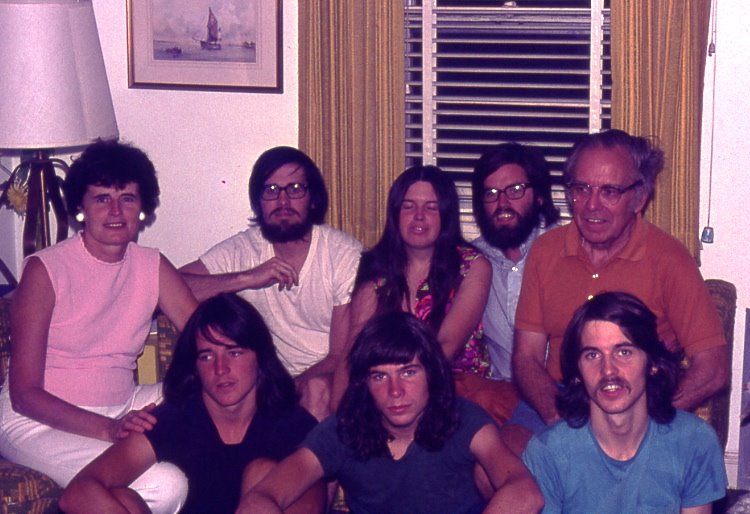
I know, it’s a love poem—and a truly bizarre choice for a description of one’s grandmother. But—getting back to photographs, and with apologies for the embarrassment this may cause certain unnamed relatives of mine--I defy you to find a better or funnier illustration of Shakespeare’s words than the picture posted above of Grandma Mary, Grandpa Joe, and their wayward offspring in the early 1970s:

She was in many ways a third parent to me. I think I’ve spent more time with my husband at this point, but I’m not at all sure of that. She was someone who could be counted on absolutely, without question or condition. She looked on tempests and was never shaken, and I’m not only talking about my uncles’ hairdos when I say that. I don’t think I’ve ever owed as much to, or cared as much about, anyone to whom I expressed it so little. But she was not the most demonstrative person either, so maybe she knew. I lack her certainty about God and heaven, but I hope very much that she knows now.